Hybrid Cars vs Electric Cars in India: Which Makes More Sense in 2026?
The year is 2026. Petrol costs ₹115 per liter. Your monthly fuel bill has crossed ₹8,000. Every visit to the fuel station feels like a financial assault.
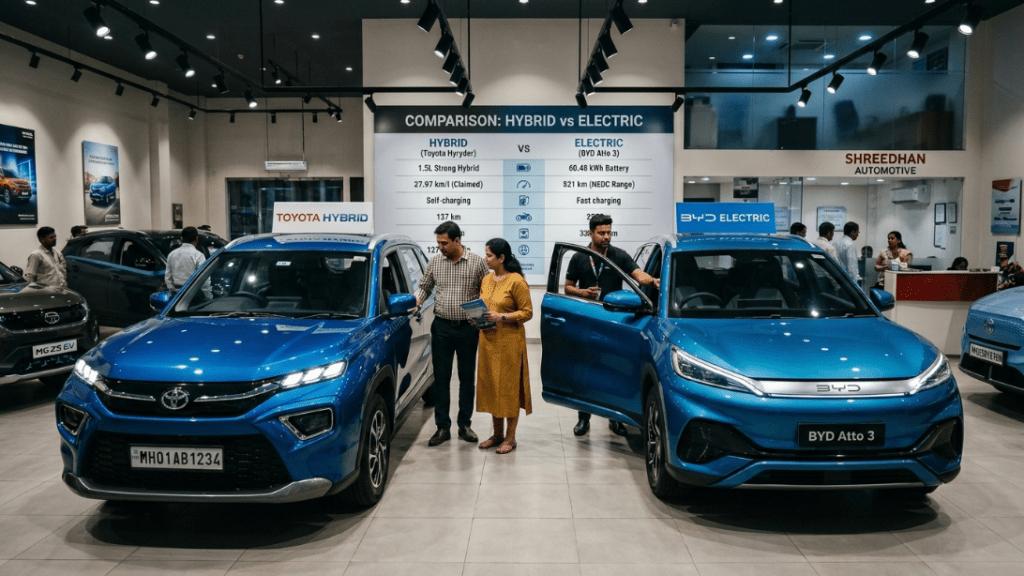
Standing in a car showroom, you’re torn between two futures. On your left sits a gleaming hybrid SUV — promising 25+ km/l mileage without charging anxiety. On your right, a sophisticated electric vehicle whispers of zero fuel costs and instant torque.
The sales executive presents compelling cases for both. “Sir, hybrid gives you best of both worlds — petrol convenience, electric efficiency.” Another voice chimes in: “EV saves ₹60,000 annually on fuel costs, plus zero emissions guilt.”
But beneath the showroom shine lies a fundamental question every Indian buyer grapples with in 2026: Which technology actually makes more sense for your real life?
This isn’t about choosing between good and bad. Both hybrids and EVs represent intelligent responses to rising fuel costs and environmental concerns. This is about choosing between two different philosophies of future mobility — and understanding which one aligns with your actual driving patterns, living situation, and financial priorities.
Welcome to India’s great automotive transition. Where the path to sustainable mobility isn’t singular — it’s a choice between two compelling technologies that solve different problems for different people.
The question isn’t which is better. The question is which is better for you.
Understanding Hybrid Cars: The Best of Both Worlds
Imagine a car that thinks for itself.
A Toyota Urban Cruiser Hyryder gliding through Bangalore traffic. The engine switches off silently at red lights. Electric motors propel the car forward — zero noise, instant response. As speed increases, the petrol engine seamlessly activates to support the electric system and recharge the battery simultaneously.
No charging cables. No range anxiety. No infrastructure dependency. Just intelligent fuel efficiency that adapts to Indian driving conditions moment by moment.
How Hybrid Technology Works
A hybrid car combines a petrol engine with an electric motor and battery system. Unlike electric vehicles that rely entirely on grid charging, hybrids generate their own electricity through regenerative braking and engine operation.
During city traffic: The electric motor handles low-speed propulsion, keeping the engine off during stop-and-go situations.
During highway cruising: The petrol engine provides primary power while continuously recharging the battery.
During acceleration: Both systems work together, delivering combined power that often exceeds what either system could produce alone.
The intelligence lies in seamless switching — the car constantly optimizes between electric and petrol power based on driving conditions, battery levels, and efficiency requirements.
Strong Hybrid vs Mild Hybrid
Strong Hybrids (like Toyota’s system in Hyryder): Can run on electric power alone at low speeds. Significant fuel savings. More complex but highly efficient.
Mild Hybrids (like Maruti’s system in Grand Vitara): Electric motor assists the petrol engine but cannot propel the car independently. Simpler, more affordable, moderate fuel savings.
Best Hybrid Cars Available in India (2026)
Toyota Urban Cruiser Hyryder Strong Hybrid:
- Mileage: 27.97 km/l
- Price: ₹15.11-18.99 lakh
- Technology: Toyota’s proven hybrid system
- Best for: Highway users wanting maximum efficiency
Maruti Suzuki Grand Vitara Strong Hybrid:
- Mileage: 27.97 km/l (same Toyota system)
- Price: ₹13.61-19.65 lakh
- Advantage: Maruti’s service network
- Best for: Value-conscious buyers wanting hybrid tech
Honda City e:HEV:
- Mileage: 26.5 km/l
- Price: ₹19.89-20.75 lakh
- Technology: Honda’s i-MMD hybrid system
- Best for: Sedan lovers wanting luxury hybrid experience
Maruti Grand Vitara Mild Hybrid:
- Mileage: 21.11 km/l
- Price: ₹12.06-17.99 lakh
- Technology: 12V mild hybrid system
- Best for: Budget-conscious buyers wanting some hybrid benefits
Understanding Electric Cars: The Zero-Emission Future
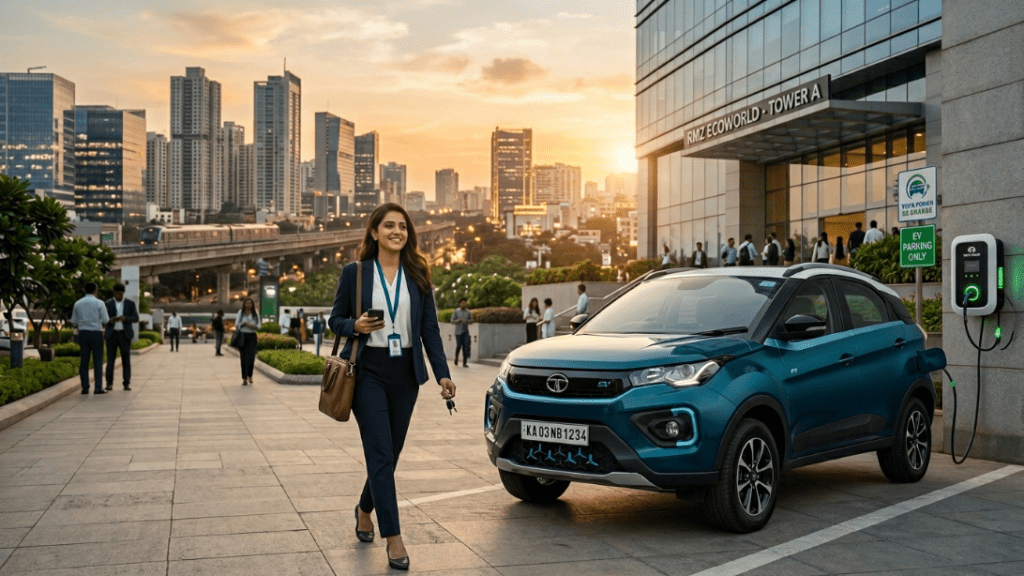
Picture this: 6 AM, Delhi winter. You walk to your Tata Nexon EV in the parking lot. No engine warm-up required. Press the start button, and you’re ready to go — instant torque, whisper-quiet operation, zero emissions.
Your daily 40-kilometer commute costs ₹80 in electricity instead of ₹320 in petrol. The regenerative braking recovers energy every time you slow down. The digital cockpit displays efficiency data that would make a Tesla owner envious.
This is electric vehicle ownership — when it works seamlessly, it feels like driving in the future.
How Electric Cars Work
Electric vehicles run entirely on battery power stored in large lithium-ion battery packs. Electric motors provide instant torque delivery — no gears, no clutch, no engine lag.
Charging happens through:
- Home charging: 6-8 hours overnight using AC charger
- Fast charging: 45-90 minutes to 80% using DC fast charger
- Public charging: Various speeds depending on charger type and vehicle compatibility
Regenerative braking recovers energy during deceleration, extending range and reducing brake wear.
Best Electric Cars Available in India (2026)
Tata Nexon EV Max:
- Range: 453 km
- Price: ₹14.74-19.14 lakh
- Fast charging: 10-80% in 56 minutes
- Best for: City commuters with charging access
Mahindra BE 6:
- Range: 535+ km
- Price: ₹18.90-26.90 lakh
- Technology: Advanced ADAS, premium cabin
- Best for: Tech enthusiasts wanting cutting-edge EV
Tata Curvv EV:
- Range: 502 km
- Price: ₹17.49-21.99 lakh
- Design: Coupe-SUV styling with premium feel
- Best for: Style-conscious buyers wanting unique design
MG ZS EV:
- Range: 461 km
- Price: ₹21.99-25.88 lakh
- Features: Premium cabin, connected tech
- Best for: Buyers wanting established EV with premium positioning
BYD Atto 3:
- Range: 521 km
- Price: ₹24.99-33.99 lakh
- Technology: Blade battery technology, rotating screen
- Best for: Premium EV buyers wanting global brand experience
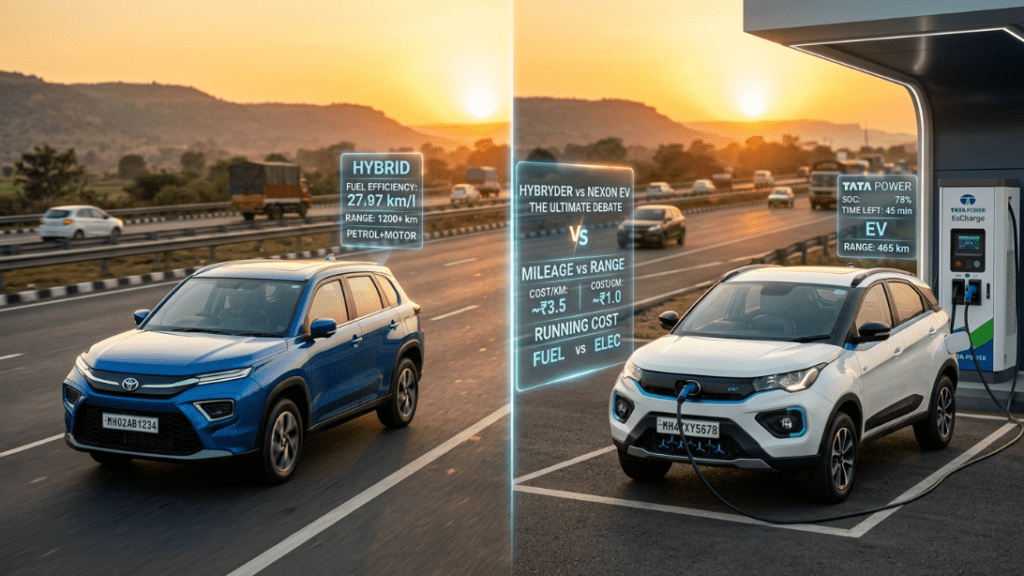
The Great Comparison: Hybrid vs EV in Real Indian Conditions
💰 Running Costs: The Daily Economics
Hybrid Cars:
- Fuel efficiency: 25-28 km/l (strong hybrid)
- Monthly cost (1,500 km): ₹6,000-7,000
- Cost per km: ₹4.50-5.00
Electric Cars:
- Home charging efficiency: 4-5 km/kWh
- Monthly cost (1,500 km): ₹2,500-3,500
- Cost per km: ₹1.50-2.50
Winner: Electric Cars — significantly lower running costs
But reality check: EV costs increase dramatically with public charging dependency. If 70% of your charging happens at public stations, monthly costs can reach ₹5,000-6,000.
🚗 Convenience & Infrastructure
Hybrid Cars:
- Use existing petrol pumps (no new infrastructure needed)
- 3-minute refueling anywhere in India
- 700+ km range on full tank
- Zero charging anxiety
Electric Cars:
- Require charging infrastructure (home or public)
- 6-8 hours home charging or 45-90 minutes fast charging
- 400-500 km range (varies with conditions)
- Trip planning required for long distances
Winner: Hybrid Cars — unmatched convenience for Indian conditions
🛣️ Long Distance Travel
Hybrid Cars:
- Delhi to Jaipur: Direct 280km drive, refuel if needed, continue
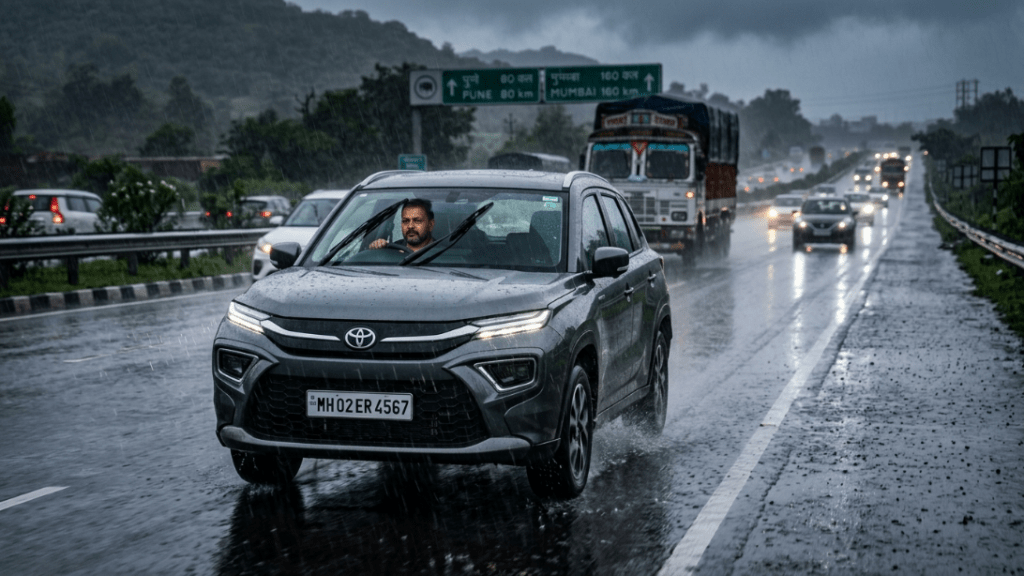
- Mumbai to Pune: Seamless 150km drive without stops
- Highway mileage: Actually improves on highways (28-30 km/l)
Electric Cars:
- Delhi to Jaipur: Plan charging stops, 45-minute break required
- Mumbai to Pune: Direct drive possible, return journey may need charging
- Highway efficiency: Decreases at high speeds (3.5-4 km/kWh)
Winner: Hybrid Cars — no compromises on long-distance travel
🏙️ City Usage
Hybrid Cars:
- Traffic advantage: Electric propulsion in stop-and-go traffic
- Silent operation at low speeds
- Regenerative braking improves city efficiency
- AC usage doesn’t dramatically affect efficiency
Electric Cars:
- Silent operation at all speeds
- Instant torque for city driving
- Zero local emissions — perfect for polluted cities
- Pre-conditioning possible while plugged in
Winner: Electric Cars — purpose-built for city efficiency
🔧 Maintenance & Reliability
Hybrid Cars:
- Conventional service + hybrid system monitoring
- Petrol engine maintenance still required
- Proven reliability (Toyota hybrids with 10+ year track record)
- Service network widely available
Electric Cars:
- Minimal mechanical maintenance (no oil changes, fewer moving parts)
- Software updates may be required
- Battery health monitoring essential
- Specialized service centers required
Winner: Electric Cars — lower long-term maintenance

💡 Technology & Performance
Hybrid Cars:
- Smooth power delivery combining electric and petrol
- CVT transmission feeling in most models
- Mature technology with known limitations
- Conventional car experience with efficiency benefits
Electric Cars:
- Instant torque delivery (0-100 km/h in 8-12 seconds typical)
- Single-speed transmission — seamless acceleration
- Advanced tech features (OTA updates, smart connectivity)
- Future-ready technology platform
Winner: Electric Cars — superior performance and tech
📈 Resale Value
Hybrid Cars:
- Strong resale value (Toyota hybrids especially)
- Conventional technology appeal to used car buyers
- Established market for hybrid resales
- No battery replacement anxiety
Electric Cars:
- Uncertain resale trajectory (market still developing)
- Battery health concerns affect valuations
- Rapid technology evolution may date current models
- Limited used EV buyer base currently
Winner: Hybrid Cars — proven resale value retention
Who Should Buy a Hybrid Car in India (2026)?
The Hybrid Sweet Spot
Highway Warriors:
- Weekly long-distance travel (200+ km trips)
- Sales professionals covering multiple states
- Families with regular inter-city travel
Apartment Dwellers:
- No charging infrastructure at home
- Society restrictions on charger installation
- Public charging dependency concerns
Efficiency Seekers Without Compromise:
- Want maximum mileage without lifestyle changes
- Value reliability and proven technology
- Prefer gradual transition from petrol cars
Small Town/Rural Users:
- Limited charging infrastructure in their area
- Service network accessibility concerns
- Conventional driving patterns (mixed city-highway)
Real Hybrid Success Stories
Suresh, Sales Manager, Pune:
“My Grand Vitara hybrid averages 26 km/l. Monthly Pune-Mumbai trips are stress-free. No charging planning, no infrastructure worry. Best upgrade from my old Creta — save ₹40,000 annually on fuel.”
Priya, Doctor, Kochi:
“Honda City e:HEV perfect for my clinic visits across Kerala. Silent in city traffic, efficient on highways. Patients notice the quiet car. Premium feel with practical efficiency.”
Who Should Buy an Electric Car in India (2026)?
The EV Sweet Spot
Urban Commuters:
- Fixed daily routes under 100 km
- Home charging access (independent house or charging-friendly society)
- Predictable travel patterns (office-home routine)
High Mileage City Users:
- Annual driving 15,000+ km (cost savings justify any inconvenience)
- Predominantly city driving (85%+ urban usage)
- Tech-forward mindset (comfortable with software updates, connectivity)
Environmentally Conscious Buyers:
- Zero emission priority for air quality concerns
- Willing to adapt lifestyle for sustainability goals
- Early adopter personality (comfortable with newer technology)
Multi-Car Families:
- EV as second car for city duties
- Petrol/hybrid primary car for long-distance travel
- Luxury of choice based on trip requirements
Real EV Success Stories
Amit, Software Engineer, Bangalore:
“Nexon EV for daily Electronic City commute. Charge at home overnight, costs ₹150 per week vs ₹800 in petrol. Office has charging too. Perfect for my routine.”
Neha, Marketing Head, Mumbai:
“Curvv EV for Bandra-Lower Parel daily travel. Fast charging at malls during weekend shopping. Style statement + savings. Love the instant acceleration in traffic.”
The Best Hybrid vs EV Recommendations by Category
Best Overall Efficiency
Hybrid Winner: Toyota Urban Cruiser Hyryder Strong Hybrid
- 27.97 km/l without charging requirements
- ₹15.11 lakh starting price
- Proven Toyota reliability
EV Winner: Tata Nexon EV Max
- ₹2/km running cost with home charging
- 453 km range sufficient for most users
- ₹14.74 lakh starting price
Best for Families
Hybrid Winner: Maruti Grand Vitara Strong Hybrid
- Maruti service network confidence
- Spacious cabin and boot space
- No lifestyle compromises for family travel
EV Winner: Tata Curvv EV
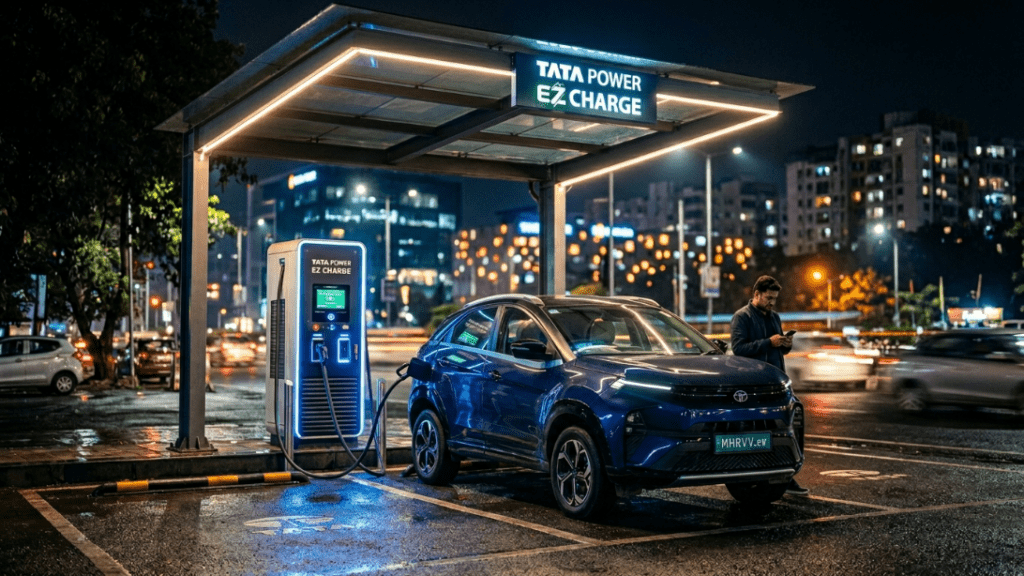
- 502 km range for family trips
- Premium cabin experience
- Unique design that kids love
Best Premium Choice
Hybrid Winner: Honda City e:HEV
- Sedan luxury with hybrid efficiency
- 26.5 km/l in premium package
- Honda refinement and features
EV Winner: BYD Atto 3
- 521 km range with premium global brand
- Rotating screen and advanced tech
- Blade battery safety technology
Best Value for Money
Hybrid Winner: Maruti Grand Vitara Mild Hybrid
- 21+ km/l at accessible price
- ₹12.06 lakh starting price
- Mild hybrid benefits without complexity
EV Winner: Tata Nexon EV Max
- Lowest total cost of ownership for high-mileage users
- Strong brand trust in Indian EV market
- Comprehensive feature list
The 2026 Reality Check: Hybrid vs EV in Indian Context
Current Market Dynamics
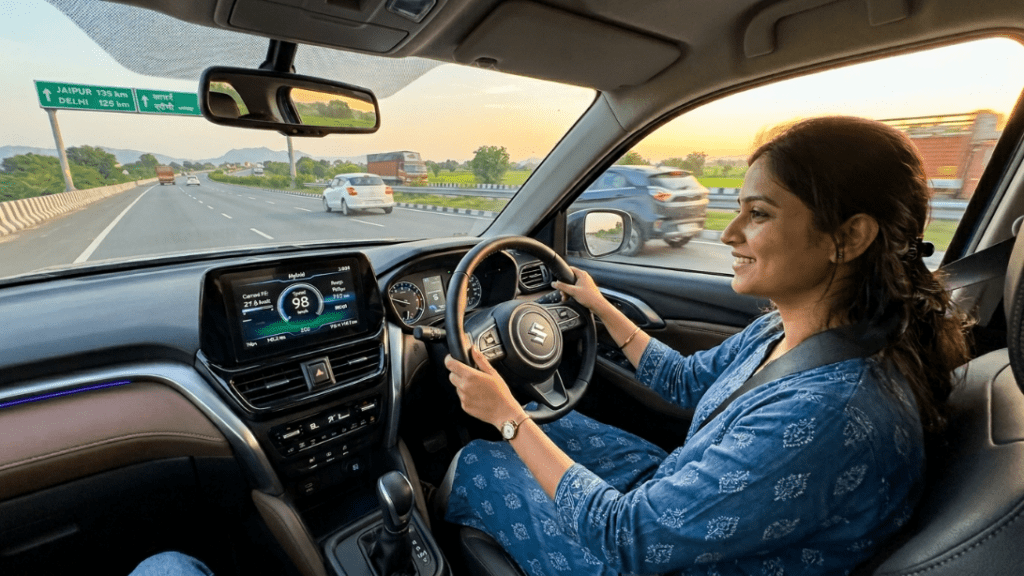
Hybrid cars are having their moment in India. Rising petrol prices made efficiency crucial, but charging infrastructure limitations kept full electric adoption cautious. Strong hybrids offer 25+ km/l without any lifestyle changes — appealing to practical Indian families.
Electric cars are gaining serious momentum. Improved charging networks, better range, and software sophistication make EVs compelling for urban buyers. The 400-500 km range addresses most Indian family travel needs.
Infrastructure Reality
Petrol pumps: 83,000+ locations across India
EV charging stations: 12,000+ (growing rapidly but still limited in smaller cities)
This infrastructure gap explains why hybrids feel “safer” for many Indian buyers — you get efficiency benefits without infrastructure dependency.
Financial Mathematics
Break-even analysis for typical Indian usage (15,000 km annually):
Hybrid vs Petrol: Break-even in 18-24 months through fuel savings
EV vs Petrol: Break-even in 12-18 months (with home charging)
EV vs Hybrid: EVs save additional ₹30,000-50,000 annually (home charging scenario)
Future Trajectory (2026-2030)
Hybrids will likely dominate the transition period as bridge technology — offering immediate efficiency without infrastructure concerns.
EVs will become mainstream as charging networks expand and battery costs fall further — especially in metro cities with established infrastructure.
Both technologies will coexist serving different buyer segments and usage patterns.
Regional Considerations for Indian Buyers
Metro Cities (Delhi, Mumbai, Bangalore, Chennai)
EV Infrastructure: Good and improving rapidly
Hybrid Advantage: Traffic efficiency, no charging dependency
Recommendation: Both viable — choose based on personal usage patterns
Tier-1 Cities (Pune, Hyderabad, Ahmedabad, Kolkata)
EV Infrastructure: Developing but gaps exist
Hybrid Advantage: Complete independence from charging network
Recommendation: Hybrids slightly preferred for reliability
Tier-2 Cities (Indore, Bhopal, Kochi, Coimbatore)
EV Infrastructure: Limited but expanding
Hybrid Advantage: No infrastructure risk
Recommendation: Hybrids strongly preferred until infrastructure matures
Smaller Towns/Rural Areas
EV Infrastructure: Very limited
Hybrid Advantage: Total flexibility
Recommendation: Hybrids almost essential for practical mobility
Wheelinity Expert Verdict
After analyzing real ownership experiences, market trends, and infrastructure realities, here’s our editorial position:
Both hybrid and electric cars represent intelligent responses to India’s fuel cost crisis — but they solve different problems for different buyers.
Hybrids excel as universal solutions. They deliver remarkable efficiency (25+ km/l) without asking owners to change their lifestyle, travel patterns, or infrastructure dependencies. For the majority of Indian buyers in 2026 — especially those outside metro cities or with regular long-distance travel — hybrids offer the optimal balance of efficiency and convenience.
Electric cars excel as specialized solutions. For urban buyers with charging access and predictable travel patterns, EVs deliver superior economics and environmental benefits. The running cost advantage is substantial, the technology is more advanced, and the driving experience feels genuinely futuristic.
Our recommendation: Choose hybrids if you want efficiency without compromise. Choose EVs if your lifestyle matches their strengths and you’re comfortable with the infrastructure requirements.
The “better” choice depends entirely on your actual usage patterns, living situation, and risk tolerance regarding new technology.
Conclusion: The Future is Flexible
India’s automotive transition isn’t about replacing one technology with another — it’s about having choices that match diverse Indian lifestyles.
The executive in Gurgaon who drives 200 km daily in predictable city traffic may find an EV transformative — saving ₹60,000 annually while enjoying silent, instant performance.
The sales manager in Indore who covers three states weekly may find a hybrid liberating — achieving 28 km/l efficiency without any infrastructure anxiety or trip planning stress.
Both buyers are making intelligent decisions. Both technologies address real problems in different ways.
The beauty of 2026 is choice. For the first time in Indian automotive history, buyers can access dramatically improved fuel efficiency through multiple technology paths. Whether you choose the proven reliability of hybrid systems or the advanced capabilities of electric powertrains, you’re participating in India’s broader shift toward sustainable mobility.
The question isn’t whether hybrids or EVs will “win” in India. The question is which one fits your life today — while the infrastructure, technology, and market continue evolving around both.
In 2026, the smartest Indian car buyers aren’t choosing between right and wrong. They’re choosing between two different versions of right.
Choose the one that feels right for your roads, your routine, and your peace of mind.
The future of Indian mobility is flexible. And that flexibility is exactly what Indian buyers deserve.
Frequently Asked Questions
Q1: Which is better for Indian roads — hybrid or electric cars?
A: Both are excellent for Indian roads, but serve different needs. Hybrids work better for long-distance travel and areas with limited charging infrastructure. EVs excel in city driving with home charging access. Choose based on your primary usage pattern and charging convenience.
Q2: What’s the real difference in running costs between hybrid and electric cars?
A: EVs cost ₹1.50-2.50 per km (with home charging), while hybrids cost ₹4.50-5.00 per km. However, EV costs can double with public charging dependency. For high-mileage users (15,000+ km annually), EVs save ₹30,000-50,000 more than hybrids annually.
Q3: Do hybrid cars require special maintenance in India?
A: Hybrid cars require conventional petrol car maintenance plus periodic hybrid system checks. Overall maintenance is slightly higher than regular petrol cars but lower than EVs requiring specialized service centers. Most authorized service centers now handle hybrid technology competently.
Q4: Are electric cars practical for highway travel in India in 2026?
A: EVs are increasingly practical for highway travel in metro corridors (Delhi-Jaipur, Mumbai-Pune, Bangalore-Chennai) with developing fast charging networks. However, for routes through smaller towns or frequent long-distance travel, hybrids remain more convenient and reliable.
Q5: Which technology has better resale value — hybrid or electric?
A: Currently, hybrid cars (especially Toyota models) have stronger resale value due to proven reliability and established used car market. Electric car resale values are still stabilizing as the technology matures. Battery health concerns affect EV resale more than hybrid systems.
