
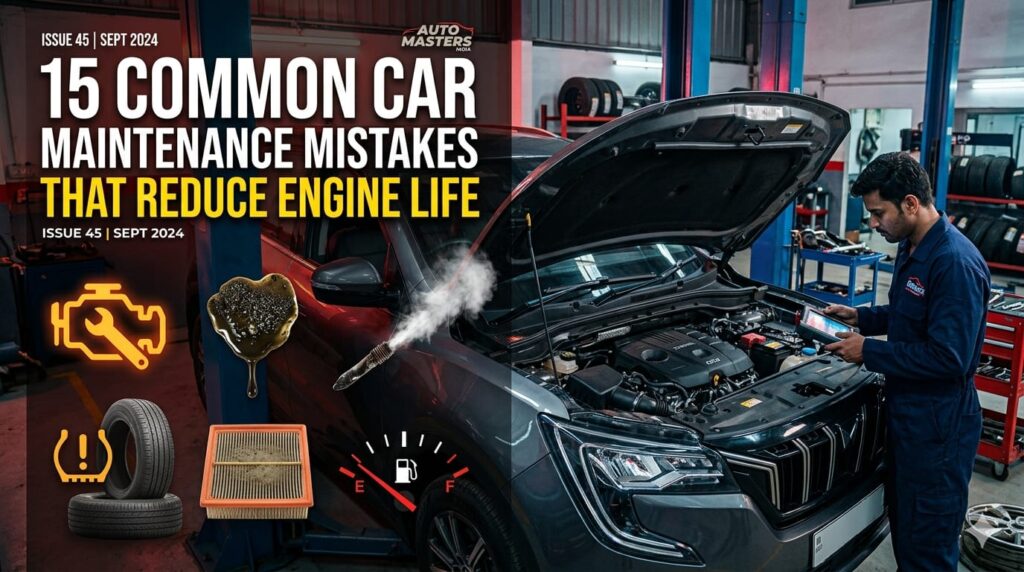
15 Common Car Maintenance Mistakes That Reduce Engine Life
Engine Care · 2026 Guide
By Wheelinity Editorial Team · May 2026 · 15 min read
Most Indian car owners unknowingly commit at least 5 of these mistakes every single month. Here’s how to stop — before a small habit turns into a ₹1.5 lakh repair bill.
📌About This Article
This guide covers 15 proven engine-damaging habits that car owners across India ignore daily. Whether you drive a Maruti Swift, Hyundai Creta, or a Tata Nexon — these mistakes apply to every car, every engine.
Your car’s engine is not just a machine — it’s the heart of your vehicle. And just like your heart, it demands consistent care. The truth is, most engine failures don’t happen suddenly. They build up slowly, silently, over months — fuelled by small mistakes that seem harmless at the time.
From skipping an oil change by “just a few hundred kilometres” to blasting the AC right after a cold start, these habits quietly chip away at your engine’s lifespan. And in India — where roads are rough, traffic is heavy, temperatures spike to 45°C in summer, and dust is everywhere — the damage compounds faster than you’d think.
We’ve spoken to experienced mechanics at workshops in Delhi, Mumbai, Bengaluru, and Chennai to compile this guide. These are the real mistakes they see every day, along with what it costs drivers who learn the hard way.
📋 Table of Contents
- Skipping Regular Oil Changes
- Ignoring Engine Warning Lights
- Driving with Low Coolant
- Delaying Air Filter Replacement
- Using Poor Quality Fuel
- Aggressive Acceleration & Braking
- Ignoring Unusual Engine Noises
- Overloading the Vehicle
- Not Checking Tyre Pressure
- Delaying Scheduled Servicing
- Driving with Overheating Issues
- Using Wrong Engine Oil
- Ignoring Battery Maintenance
- Driving on Reserve Fuel
- Poor Cold-Start Driving Habits
01 Skipping Regular Oil Changes
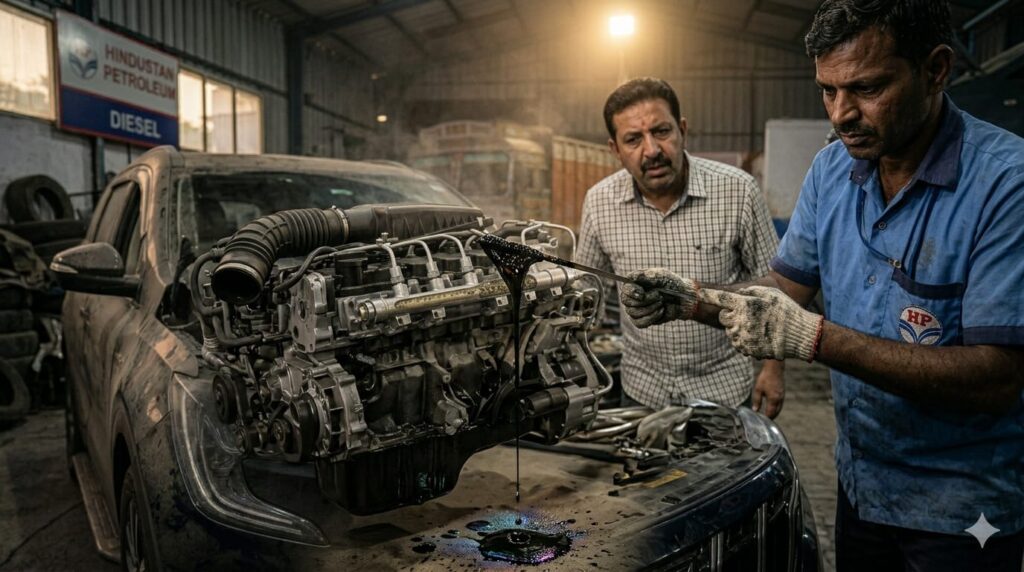
Engine oil is the lifeblood of your engine. It lubricates hundreds of moving metal parts, reduces friction, cleans internal deposits, and keeps temperatures in check. Yet, thousands of Indian car owners delay oil changes because they “don’t notice any difference” or because the service centre is too far.
Here’s the problem: used engine oil breaks down over time. Its viscosity drops, additives deplete, and it starts carrying metal particles and sludge. When old oil circulates, it no longer protects — it accelerates wear instead.
Why People Make This Mistake
The most common reason? Out of sight, out of mind. Unlike fuel, oil consumption is invisible to most drivers. Many also believe the myth that modern synthetic oils “last forever” or that the service interval is flexible.
Warning Signs
- Dark, thick, or gritty oil on the dipstick
- Engine knocking or ticking sounds
- Oil pressure warning light on the dashboard
- Burning oil smell from the engine bay
- Smoke from the exhaust
Prevention Tips
- Change engine oil every 5,000–7,500 km for mineral oil, 10,000–15,000 km for synthetic
- Always replace the oil filter along with the oil
- Keep a logbook — or set a Google Calendar reminder — for your next oil change
- Use your car manufacturer’s recommended oil grade (e.g., 5W-30, 10W-40)
✅Pro Tip
In Indian summers (40°C+), engine oil degrades faster than in cooler climates. If your car is mostly used for short stop-and-go commutes in cities like Delhi or Hyderabad, err on the lower end of the oil change interval. Short trips don’t fully warm up the engine, which accelerates oil contamination.
⚠️ Repair Cost₹1,500 – ₹4,000oil change vs. ₹80,000–₹2,00,000 engine overhaul
02 Ignoring Engine Warning Lights
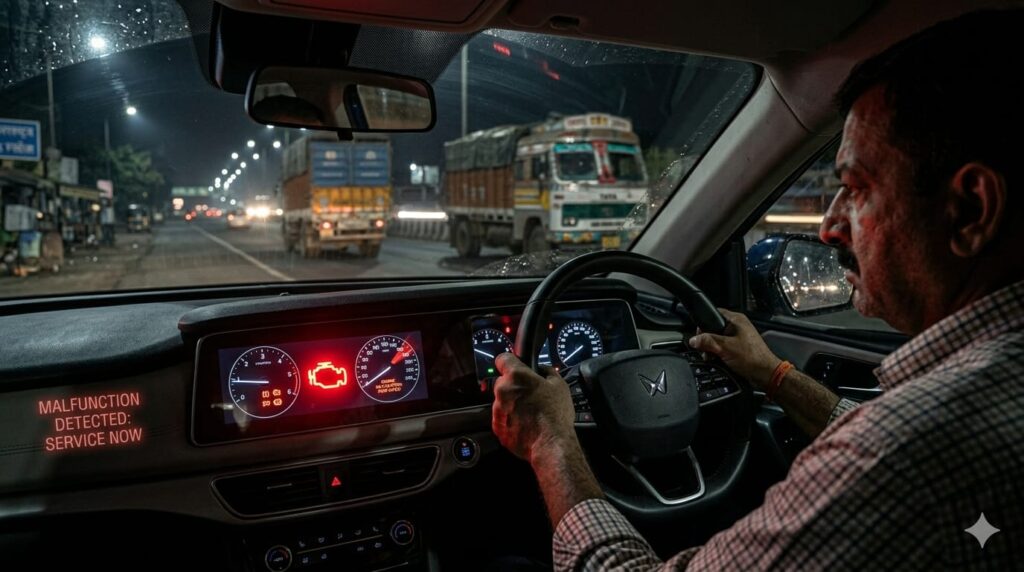
Your car’s dashboard has multiple warning lights for good reason. The “Check Engine” light, oil pressure light, temperature warning — these aren’t decorative. They’re your car screaming for help. Ignoring them is like putting tape over a smoke alarm and going back to sleep.
In India, it’s distressingly common to see cars running for weeks — sometimes months — with the engine warning light glowing. “It’s probably nothing” is one of the most expensive assumptions a driver can make.
How It Damages the Engine
Warning lights can indicate anything from a loose fuel cap to a failing oxygen sensor, a misfiring cylinder, or critically low oil pressure. When misfires go untreated, they can damage catalytic converters (₹20,000–₹50,000 to replace). When low oil pressure is ignored, the engine can seize within minutes of driving.
Warning Signs
- Any dashboard warning light, especially the “Check Engine” or “Engine Temperature” light
- Reduced engine performance alongside a lit warning light
- Unusual smells or sounds that appear with the light
🚨Critical Warning
A flashing “Check Engine” light (not steady) indicates a severe misfire that can cause immediate catalytic converter damage. Pull over safely and call for assistance — do not continue driving.
Prevention Tips
- Get a basic OBD-II scanner (₹800–₹2,500 on Amazon) to read diagnostic codes yourself
- Visit a trusted mechanic within 24–48 hours of any warning light appearing
- Never assume a warning light is a sensor malfunction without checking
⚠️ Repair Cost₹500 – ₹60,000+depending on underlying issue; catching it early saves lakhs
03 Driving with Low Coolant
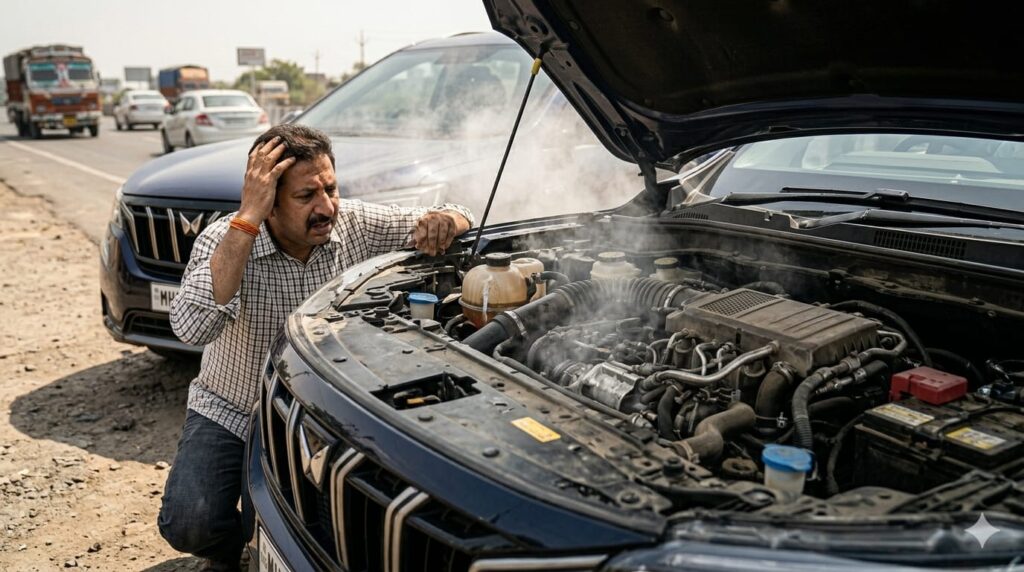
Engine coolant (also called antifreeze) absorbs heat from the engine and dissipates it through the radiator. Without adequate coolant, your engine overheats — and overheating is one of the single most destructive things that can happen to an engine. Head gaskets warp, cylinders crack, and entire engines can fail.
In India’s summer months — when ambient temperatures easily cross 40°C — a low coolant situation becomes dangerous within minutes of driving, especially in traffic.
Why People Make This Mistake
Coolant levels are rarely checked by routine drivers. Many people only open the bonnet during a breakdown or service visit. The coolant reservoir is often tucked away and not part of a weekly walk-around check.
Warning Signs
- Temperature gauge needle climbing toward red
- Steam or smoke rising from under the bonnet
- Sweet burning smell (coolant has a distinctive sweet scent)
- Heater not working properly
- Low coolant warning light (on modern cars)
💡Did You Know?
A cracked head gasket — often caused by overheating — can cost ₹25,000 to ₹80,000 to repair in India. In severe cases, it can total a budget car. All because of a fluid that costs ₹300 per litre.
Prevention Tips
- Check coolant level monthly (when the engine is cold)
- Use the correct coolant-to-water ratio as specified in your owner’s manual (typically 50:50)
- Flush and replace coolant every 2 years or 40,000 km
- Use distilled water, not tap water, when topping up
⚠️ Repair Cost₹300 (coolant top-up) vs. ₹25,000–₹1,50,000for head gasket or engine block repair
04 Delaying Air Filter Replacement
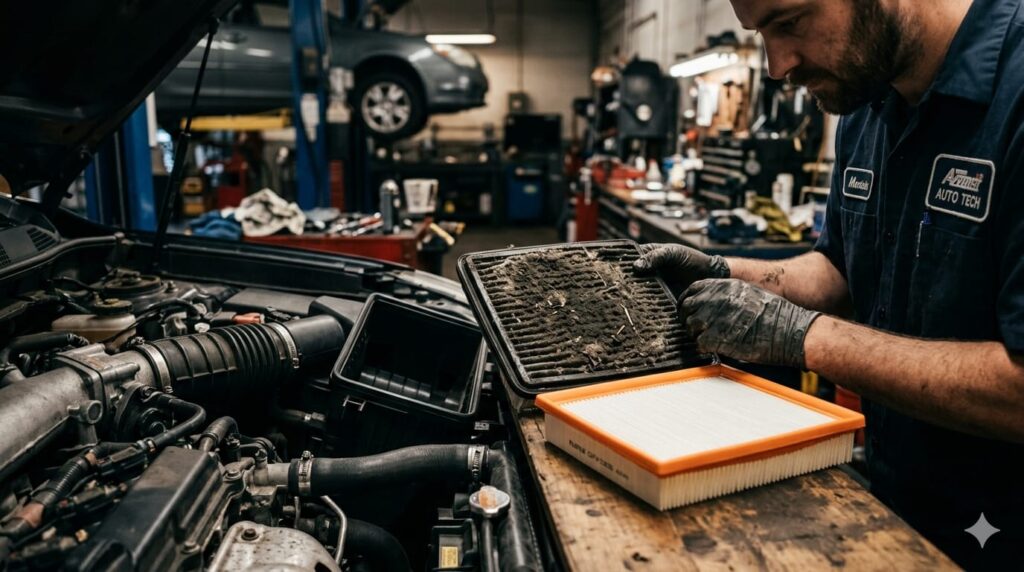
Your engine is essentially a giant air pump. It needs clean, unrestricted airflow to combust fuel efficiently. The air filter is the only thing standing between the outside air — full of dust, pollen, and particulate matter — and your engine’s sensitive internals.
In a country like India, where road dust, construction debris, and traffic pollution are a daily reality, air filters clog faster than anywhere else. A blocked air filter is like making your engine breathe through a wet cloth.
How It Damages the Engine
A clogged air filter restricts airflow, causing a rich fuel mixture (too much fuel, not enough air). This leads to incomplete combustion, carbon deposits on pistons and valves, increased fuel consumption, and over time, significant power loss and engine wear.
Warning Signs
- Visibly dirty or black air filter during inspection
- Reduced fuel efficiency (more refuelling stops)
- Engine feels sluggish, especially under acceleration
- Black smoke from the exhaust
Prevention Tips
- Check the air filter every 10,000 km; replace every 15,000–20,000 km (earlier in dusty cities)
- If you drive on unpaved roads or in construction zones, check every 5,000 km
- A quality OEM air filter costs ₹300–₹1,200 — it’s the cheapest engine protection available
- Consider a performance air filter for longer intervals but follow cleaning schedules
✅Expert Mechanic Tip
In cities like Gurgaon, Noida, or Faridabad — where construction dust is constant — replace your air filter every 10,000 km, not 20,000 km. The difference in engine breathing, fuel economy, and long-term health is significant.
⚠️ Repair Cost₹300–₹1,200 (filter) vs. ₹8,000–₹40,000carbon cleaning or valve repair from neglect
05 Using Poor Quality Fuel
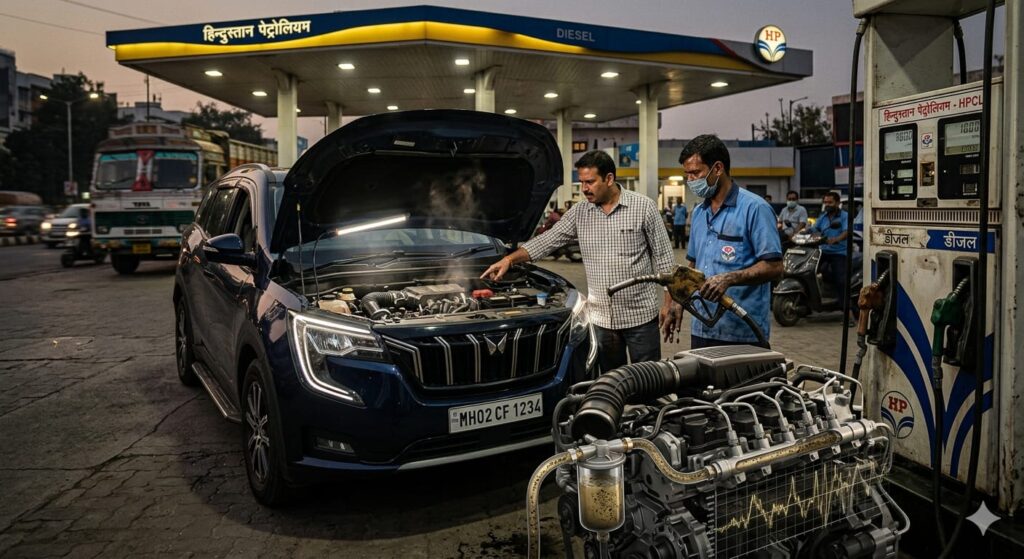
Not all petrol is created equal. India has seen significant improvements in fuel quality with BS6 standards, but adulterated fuel — mixed with kerosene or low-octane petrol — still exists, particularly at some roadside pumps in smaller towns. Even within legitimate options, using the wrong octane rating for your engine matters.
How It Damages the Engine
Low-quality or adulterated fuel causes engine knocking (premature ignition), deposits on fuel injectors, clogged fuel filters, and damage to the fuel pump. Over time, it accelerates wear on pistons, cylinders, and the combustion chamber.
Warning Signs
- Engine knocking or “pinging” sound during acceleration
- Loss of power after refuelling at a new pump
- Fuel efficiency drops sharply after a particular fill-up
- Rough idle or hard starting
🔄Myth vs. Fact
Myth: Premium fuel (Speed, Power, XP100) is just a marketing gimmick and makes no real difference.
Fact: For high-compression engines in cars like Hyundai i20 N Line, VW Polo TSI, or performance SUVs, premium fuel can meaningfully improve engine efficiency, reduce knocking, and extend engine life. For a basic 1.2L engine, regular fuel is perfectly fine. Always check your owner’s manual.
Prevention Tips
- Refuel only at reputed, branded petrol stations (HPCL, BPCL, Indian Oil)
- Use the octane rating recommended in your owner’s manual
- If you suspect fuel adulteration, drain the tank and have the fuel system cleaned
- Add a quality fuel system cleaner every 20,000–30,000 km
⚠️ Repair Cost₹3,000–₹15,000fuel injector cleaning/replacement; severe cases: ₹40,000+
06 Aggressive Acceleration and Braking
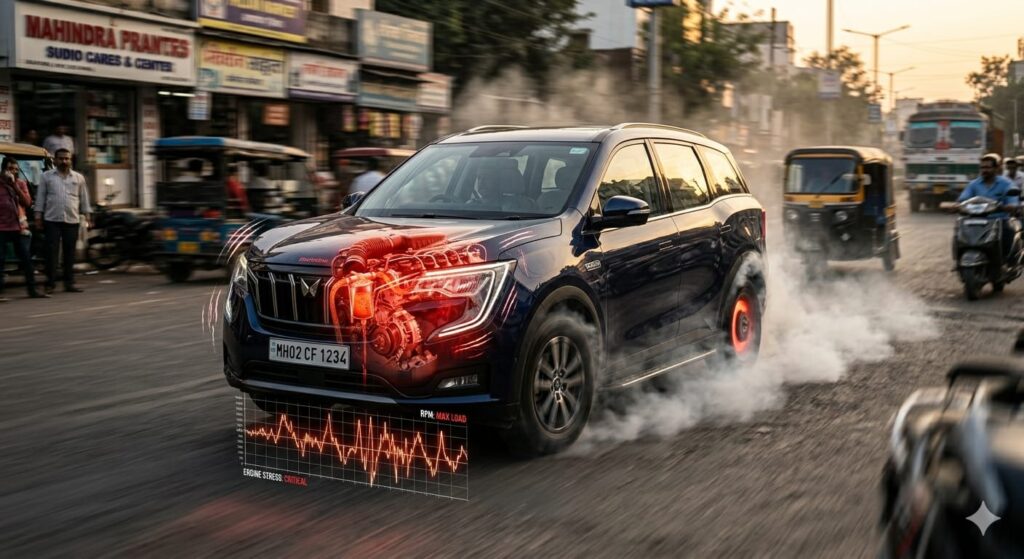
India’s traffic is chaotic, and many drivers develop a pattern of hard acceleration followed by sudden braking — a stop-and-go habit that punishes every component of the drivetrain. Aggressive driving is the enemy of engine longevity.
How It Damages the Engine
Rapid acceleration forces the engine to work at peak load repeatedly, stressing pistons, connecting rods, and the crankshaft. It also burns more fuel per kilometre, generates excess heat, and accelerates oil degradation. Hard braking wastes the energy the engine just produced and wears brake pads and rotors prematurely.
Warning Signs
- Fuel economy significantly below the manufacturer’s claimed figure
- Engine running hotter than usual in traffic
- Premature brake pad wear
💡Did You Know?
Studies show that smooth driving — gentle acceleration and gradual braking — can improve fuel efficiency by 15–30% and significantly reduce engine wear. On India’s highways, the difference between a driver doing 80 km/h steadily vs. 100+ km/h in bursts is often 4–5 km/l in mileage.
Prevention Tips
- Accelerate smoothly — imagine a full cup of tea on the dashboard that you don’t want to spill
- Anticipate traffic and brake gradually rather than suddenly
- Use higher gears at lower speeds where possible (for petrol engines)
- Maintain a safe following distance to avoid panic braking
⚠️ Long-term Impact₹20,000–₹50,000/yearin extra fuel, brakes, tyres, and accelerated engine wear
07 Ignoring Unusual Engine Noises
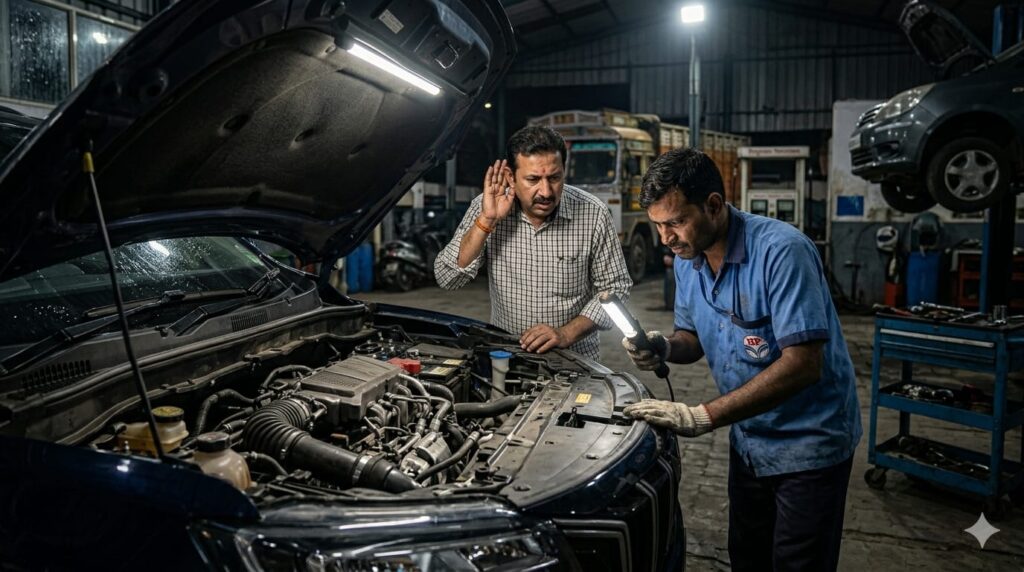
Every engine has its rhythm. When something new appears — a knock, a rattle, a whine, a squeal — that’s your engine communicating a problem. Drivers who turn up the music to drown out the noise are setting themselves up for much bigger trouble.
Common Noises and What They Mean
- Knocking/pinging: Low oil pressure, wrong fuel, bearing wear
- Ticking/tapping: Low oil level, valve train issues, worn lifters
- Rattling on startup: Timing chain slack, low oil
- Squealing: Worn belts (serpentine or timing)
- Hissing: Vacuum leak or coolant leak
- Grinding: Metal-on-metal contact — stop driving immediately
🚨Critical Warning
A loud knocking sound from the engine, especially one that worsens with acceleration, is typically a sign of bearing failure. Continuing to drive can destroy the engine within minutes. This is a “pull over now” situation, not a “get it checked next weekend” situation.
Prevention Tips
- Turn off the radio briefly each week and listen to your engine at idle and during acceleration
- Investigate any new sound within 48 hours — don’t wait for the next service
- A mechanic’s inspection for unusual sounds costs ₹200–₹500; fixing the underlying issue early saves lakhs
⚠️ Repair Cost₹5,000–₹2,50,000depending on whether caught early (minor) or late (engine rebuild)
08 Overloading the Vehicle
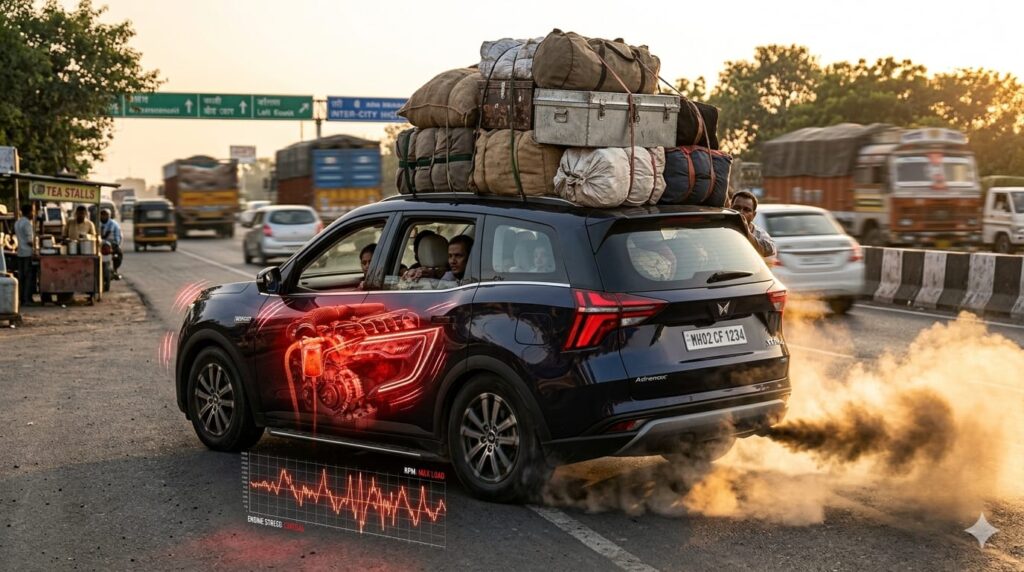
Every car has a Gross Vehicle Weight Rating (GVWR) — the maximum weight it can safely carry, including passengers, luggage, and fuel. Exceeding this puts enormous strain on the engine, transmission, suspension, tyres, and brakes. In India, this is especially common during festivals, weddings, and long road trips where families pack in extra passengers and luggage.
How It Damages the Engine
When overloaded, the engine must work significantly harder to accelerate and maintain speed. It runs at higher RPMs for longer, generating more heat and burning more fuel. This accelerates wear on pistons, connecting rods, and the entire drivetrain. Diesel engines are particularly vulnerable to turbocharger stress under overloading.
Warning Signs
- Engine temperature rising higher than normal
- Noticeable loss of power, especially uphill
- Suspension bottoming out over bumps
- Increased fuel consumption
Prevention Tips
- Check your car’s payload capacity in the owner’s manual (typically 400–600 kg for hatchbacks)
- Don’t use roof carriers for heavy items — they shift the vehicle’s centre of gravity dangerously
- For long-distance travel with full load, stop more frequently to let the engine cool
⚠️ Repair Cost₹10,000–₹80,000suspension, transmission, and engine stress repairs
09 Not Checking Tyre Pressure
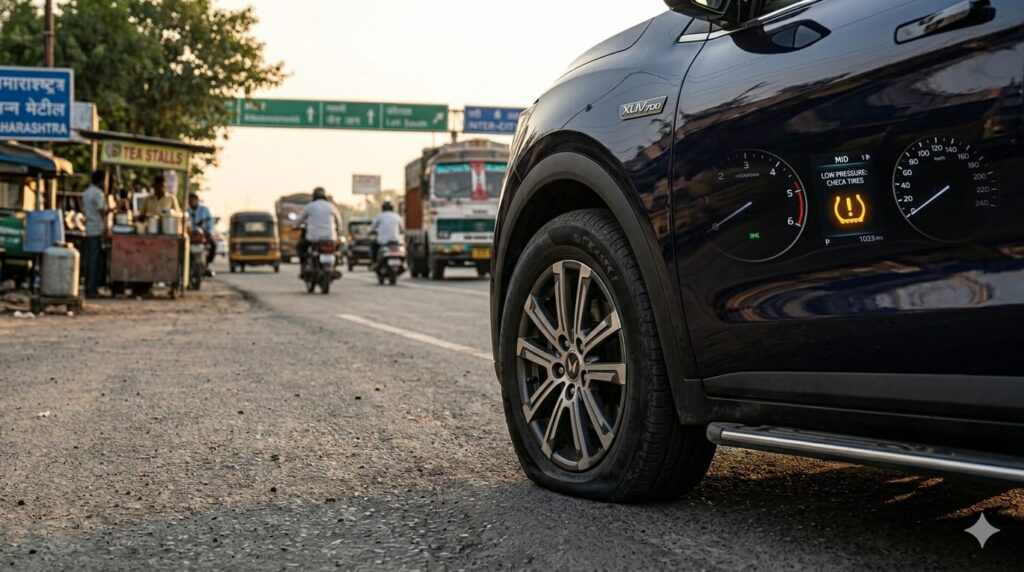
Tyre pressure might seem unrelated to the engine, but it has a direct connection. Under-inflated tyres create significantly more rolling resistance, which means the engine must work harder to move the car at the same speed. Over time, this increases fuel consumption, stresses the engine, and shortens the life of every component in the drivetrain.
Warning Signs
- TPMS (Tyre Pressure Monitoring System) warning light
- Visibly flat-looking tyre
- Car pulling to one side
- Reduced fuel efficiency
- Excessive heat from tyres after driving
Prevention Tips
- Check tyre pressure every two weeks, always when tyres are cold
- Follow the recommended PSI on the sticker inside the driver’s door jamb
- In summer, expect pressure to increase by 2–3 PSI — that’s normal; don’t release air to compensate
- Don’t forget the spare tyre — check it every month
✅Pro Tip
A digital tyre pressure gauge costs ₹300–₹500 and fits in your glove box. Most petrol stations in India have free air fill points, though the gauges aren’t always calibrated correctly. Your own gauge gives you accurate, consistent readings.
⚠️ Repair Cost₹4,000–₹20,000premature tyre replacement; indirect engine wear costs more long-term
10 Delaying Scheduled Servicing
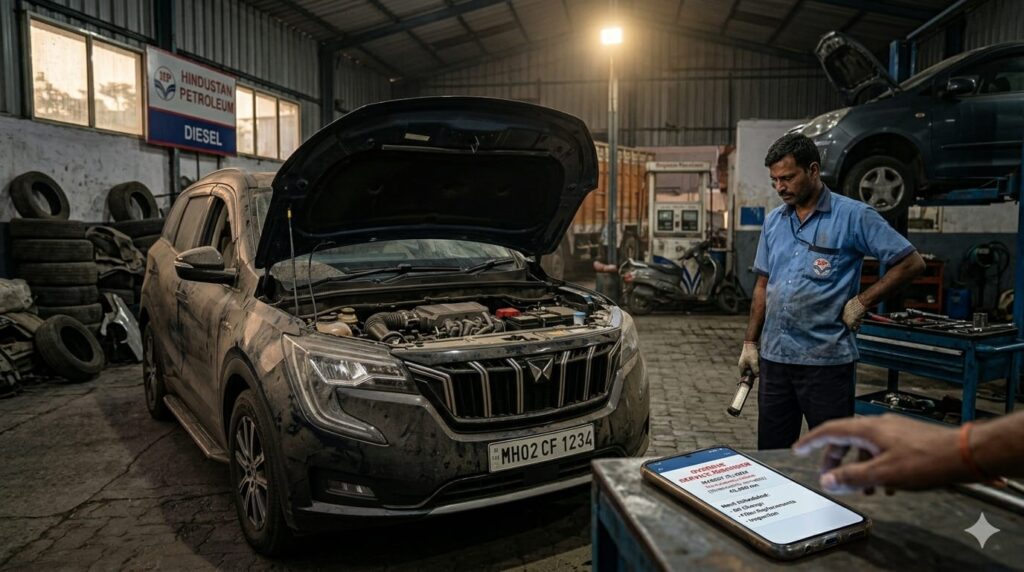
Manufacturer-scheduled servicing exists for a reason. At each service interval, dozens of components are inspected, adjusted, lubricated, and replaced as needed. Skipping or delaying these services doesn’t save money — it defers costs while allowing problems to silently compound.
How It Damages the Engine
Beyond oil and filter changes, scheduled services include checking coolant concentration, inspecting spark plugs, checking drive belts and timing belts, cleaning fuel injectors, and checking transmission fluid levels. Missing these intervals means problems go undetected until they become catastrophic.
⚠️Important: Timing Belt
In interference engines (common in many Indian cars — Maruti, Hyundai, Honda), a snapped timing belt can destroy the entire engine in milliseconds. The timing belt must be replaced at the manufacturer’s specified interval — typically 60,000–80,000 km. This is non-negotiable.
Prevention Tips
- Follow the service schedule in your owner’s manual, not just “when something feels wrong”
- Use a trusted authorized service centre for major services, especially timing belt replacement
- Keep all service records — they also protect your car’s resale value
⚠️ Repair Cost₹3,000–₹8,000 (scheduled service) vs. ₹80,000–₹3,00,000engine repair from deferred maintenance
11 Driving with Overheating Issues
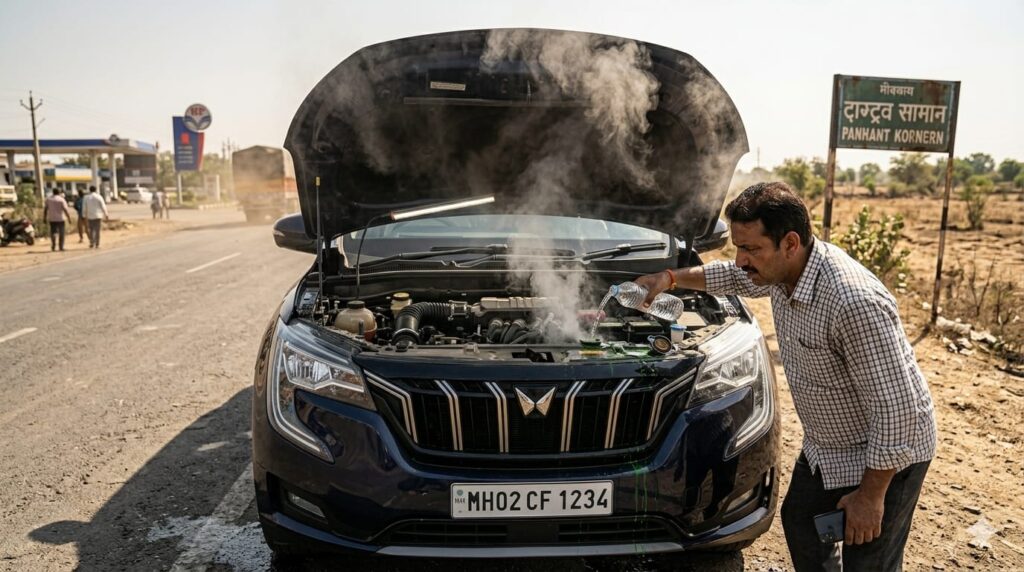
When the engine temperature gauge climbs into the red zone, the most important thing to do is stop driving immediately. Many drivers panic or — worse — think they can “push through” to the next petrol station. This is one of the most expensive mistakes you can make.
How It Damages the Engine
Extreme heat causes metal components to expand beyond tolerance. Head gaskets fail, cylinder heads warp, pistons seize in cylinders, and engine block can crack. Once an engine overheats severely, the damage is often irreversible — requiring a full engine replacement.
Warning Signs
- Temperature gauge in the red zone
- Steam/smoke from under the bonnet
- Loss of engine power
- Coolant boiling or bubbling sound
Prevention Tips
- If the temperature climbs, turn off the AC and turn on the heater (it draws heat from the engine)
- Pull over safely, turn off the engine, and wait 30–45 minutes before opening the bonnet
- Never open the radiator cap on a hot engine — boiling coolant can cause severe burns
- Call roadside assistance (most insurers include this); do not attempt to drive further
⚠️ Repair Cost₹30,000–₹2,50,000head gasket, cylinder head, or complete engine replacement
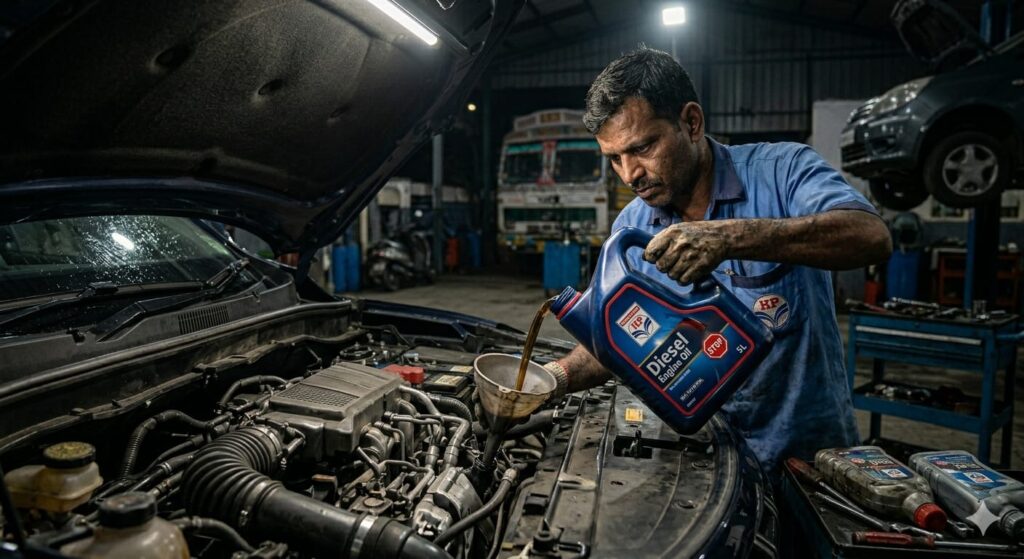
12 Using Wrong Engine Oil
Engine oil isn’t a “one size fits all” product. Viscosity grades (like 5W-30 or 10W-40), oil specifications (API SN, ACEA A3/B4), and oil type (mineral, semi-synthetic, full synthetic) all matter. Using the wrong oil — especially at a roadside garage that uses whatever is cheapest — is a slow death sentence for your engine.
How It Damages the Engine
Too thick an oil won’t circulate properly during cold starts, starving the engine of lubrication for critical seconds. Too thin an oil won’t maintain a protective film under high-temperature, high-load conditions. Wrong specifications can react badly with engine seals, leading to leaks and internal corrosion.
Prevention Tips
- Always use the oil grade printed on the oil filler cap or in the owner’s manual
- If switching from mineral to synthetic, have the engine flushed first at a trusted workshop
- Buy oil from reputed outlets — Castrol, Mobil, Shell, Gulf, Motul — not unknown brands
- Match the oil to your climate: in Rajasthan’s summer heat, a slightly higher viscosity may help
⚠️ Repair Cost₹15,000–₹1,00,000seal replacement, bearing damage, or engine seizure
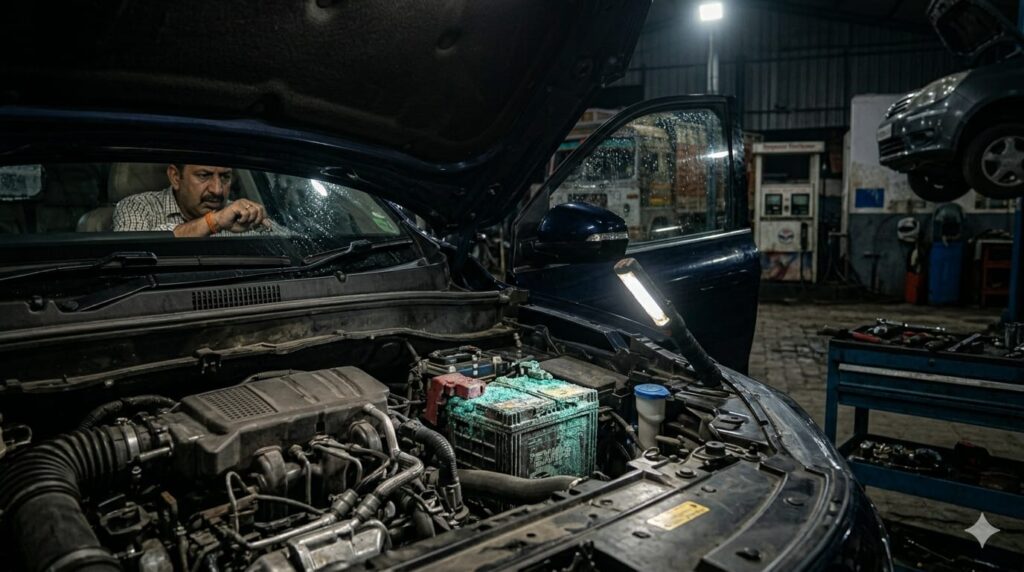
13 Ignoring Battery Maintenance
A weak or dying car battery creates a chain reaction of problems that extends far beyond just a car that won’t start. Modern car engines rely on the battery and alternator working together to power the ECU, fuel injection system, ignition coils, and dozens of sensors. A struggling battery causes the alternator to overwork, and an overworked alternator fails prematurely — costing ₹8,000–₹18,000 to replace.
Warning Signs
- Slow cranking when starting (engine turns over sluggishly)
- Lights dimming noticeably when accessories are on
- Battery warning light on the dashboard
- Corroded or white powder around battery terminals
- Car not starting at all (dead battery)
Prevention Tips
- Check battery terminals every 6 months; clean corrosion with a baking soda solution and a wire brush
- Have the battery tested for capacity at every annual service (most workshops do this free)
- Replace the battery every 3–5 years, depending on usage and climate
- If you drive short distances frequently, take a 30-minute highway drive monthly to fully charge the battery
⚠️ Repair Cost₹4,000–₹12,000 (battery) vs. ₹8,000–₹18,000alternator replacement; ₹15,000–₹40,000 for ECU damage
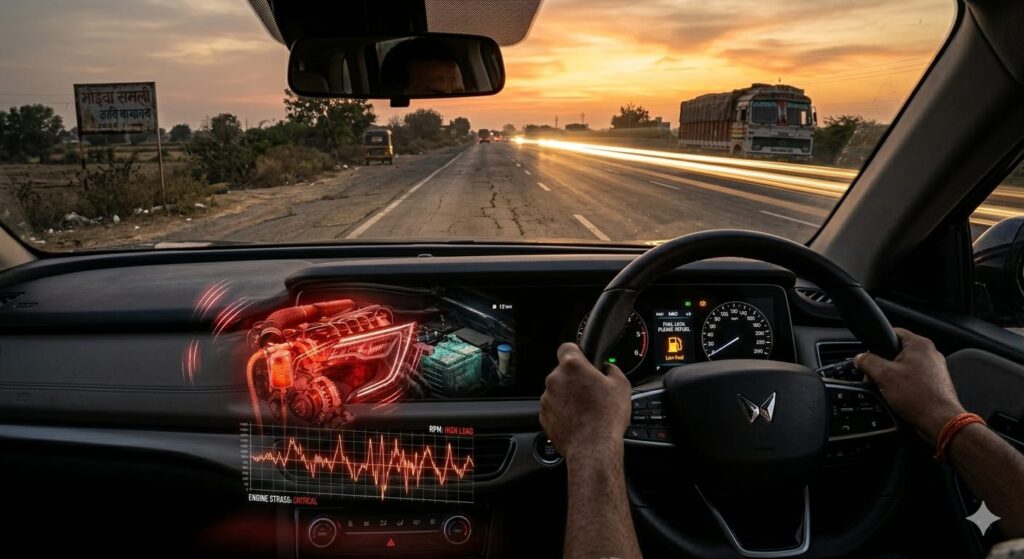
14 Frequently Driving on Reserve Fuel
Many Indian drivers habitually run their cars to the last drop before refuelling — whether to avoid making an extra stop, or out of a “see how far it goes” habit. This practice is more damaging than most people realise, particularly for modern fuel-injected cars.
How It Damages the Engine
The fuel pump in most modern cars sits inside the fuel tank. Petrol acts as a coolant and lubricant for the pump. When you drive on very low fuel, the pump runs hot and dry, degrading its lifespan rapidly. Sediment that settles at the bottom of the tank — collected over years — also gets sucked into the fuel system, clogging injectors and filters.
Warning Signs
- Fuel pump whining or whirring noise (heard near the rear of the car)
- Engine hesitation or stumbling under acceleration
- Hard starting or longer cranking time
Prevention Tips
- Refuel when the tank reaches ¼ full — make it a habit
- Never let the tank drop below the last bar of the fuel gauge regularly
- In older cars (5+ years old), have the fuel filter replaced every 40,000 km to clear sediment
⚠️ Repair Cost₹6,000–₹18,000fuel pump replacement; injector cleaning ₹3,000–₹10,000
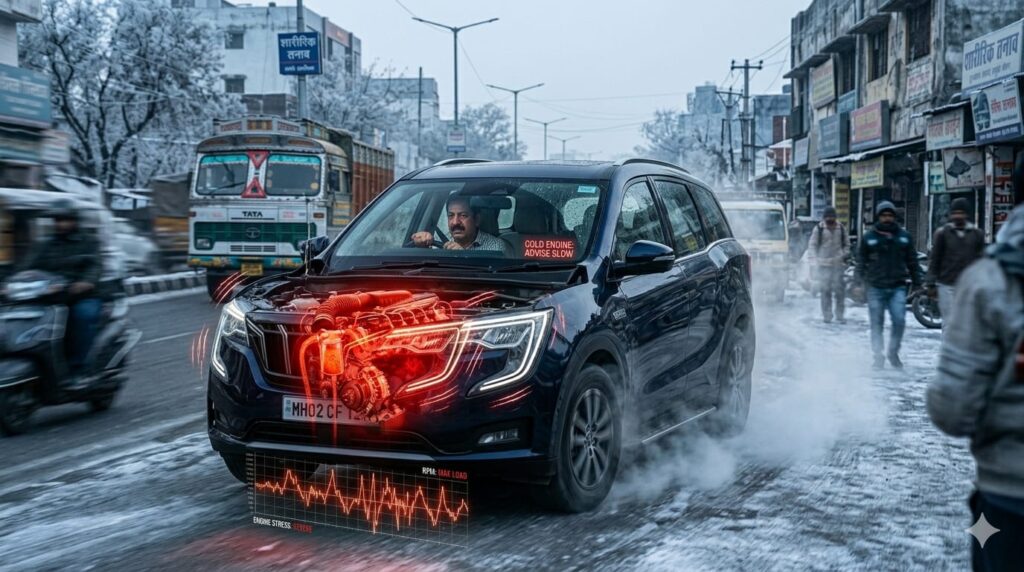
15 Poor Cold-Start Driving Habits
The 30–60 seconds immediately after you start a cold engine are the most critical for its long-term health. During this time, oil hasn’t fully circulated, metal components are contracted from cooler temperatures, and clearances between parts are slightly tighter than operating temperature. What you do in these first moments matters enormously.
Common Cold-Start Mistakes
- Revving the engine hard immediately after starting (“blipping” the throttle)
- Switching on the AC immediately and driving at full throttle
- Driving at highway speeds within the first kilometre
- In diesel cars: not waiting for the glow plug indicator to go out before cranking
How It Damages the Engine
Hard acceleration on a cold engine forces components to work at high load before oil has reached all moving parts. This causes dry-run wear — where metal surfaces contact each other without adequate lubrication for a few critical seconds. Over thousands of cold starts, this adds up to measurable engine wear that shortens engine life by years.
💡Did You Know?
Modern fuel-injected engines do not need to “warm up” for 5–10 minutes before driving. The old warm-up advice was for carburettor engines. Today, the correct approach is to start the engine and drive gently for the first 1–2 km. Driving at low speeds circulates oil faster than idling.
Prevention Tips
- After starting, wait 10–20 seconds before pulling away (gives oil time to circulate)
- Drive at gentle speeds — below 2,500 RPM — for the first kilometre or two
- Avoid using the AC on full blast immediately on a cold start in winter months
- For diesel cars, always wait for the glow plug light to turn off before starting
⚠️ Long-term Impact₹50,000–₹2,00,000cumulative engine wear reduction in lifespan; piston ring and bearing damage
Quick Reference: All 15 Mistakes at a Glance
| # | Mistake | Severity | Repair Cost (India) | Prevention Cost |
|---|---|---|---|---|
| 1 | Skipping oil changes | High | ₹80K–₹2L | ₹1,500–₹4,000 |
| 2 | Ignoring warning lights | High | ₹500–₹60K+ | ₹800 OBD scanner |
| 3 | Low coolant | High | ₹25K–₹1.5L | ₹300 coolant |
| 4 | Clogged air filter | Medium | ₹8K–₹40K | ₹300–₹1,200 |
| 5 | Poor quality fuel | Medium | ₹3K–₹40K | ₹5–10/litre more |
| 6 | Aggressive driving | Medium | ₹20K–₹50K/year | Driving habit change |
| 7 | Ignoring engine noises | High | ₹5K–₹2.5L | ₹200–₹500 inspection |
| 8 | Overloading | Medium | ₹10K–₹80K | Weight awareness |
| 9 | Wrong tyre pressure | Low–Med | ₹4K–₹20K | ₹300 gauge |
| 10 | Skipping scheduled service | High | ₹80K–₹3L | ₹3K–₹8K service |
| 11 | Driving while overheating | Critical | ₹30K–₹2.5L | Stopping immediately |
| 12 | Wrong engine oil | High | ₹15K–₹1L | ₹500–₹2K right oil |
| 13 | Battery neglect | Medium | ₹8K–₹40K | ₹4K–₹12K battery |
| 14 | Reserve fuel driving | Medium | ₹6K–₹18K | Refuelling at ¼ tank |
| 15 | Cold-start abuse | Medium | ₹50K–₹2L (cumulative) | Habit change |
Seasonal Engine Care for Indian Conditions
☀️ Summer (Mar–Jun)
- Check coolant level weekly
- Inspect radiator hoses
- Test AC refrigerant
- Park in shade when possible
🌧️ Monsoon (Jul–Sep)
- Check for water ingress in air filter
- Inspect brakes carefully
- Watch for rusting under-chassis
- Check wiper blades and lights
❄️ Winter (Nov–Feb)
- Gentle cold starts — no hard revving
- Check battery cold cranking amps
- Ensure coolant is properly mixed
- Allow extra warm-up in hills
🔧 Year-Round
- Monthly oil level check
- Bi-weekly tyre pressure check
- Watch dashboard lights daily
- Listen for new sounds weekly
🔧 Complete Car Maintenance Checklist
Check engine oil level on dipstick
Every Month
Check tyre pressure (all 4 + spare)
Every 2 Weeks
Check coolant level in reservoir
Every Month
Inspect battery terminals for corrosion
Every 6 Months
Change engine oil and filter
Every 5,000–10,000 km
Inspect and replace air filter if needed
Every 10,000–15,000 km
Complete scheduled manufacturer service
Per owner’s manual intervals
Replace spark plugs (petrol engines)
Every 30,000–60,000 km
Replace timing belt (interference engines)
Every 60,000–80,000 km
Flush and replace coolant
Every 2 Years / 40,000 km
Frequently Asked Questions
How often should I change engine oil in India?
For mineral oil, change every 5,000–7,500 km or every 6 months, whichever comes first. For semi-synthetic, every 7,500–10,000 km. For full synthetic, every 10,000–15,000 km. In India’s dusty, hot conditions — especially in cities — lean toward the shorter intervals.
What are the most common signs of engine damage?
Look for: engine knocking or ticking sounds, white/blue/black smoke from the exhaust, oil on the ground under the car, dashboard warning lights, loss of power, rough idle, unusual fuel consumption, and coolant in the engine oil (milky oil on the dipstick).
Can aggressive driving really damage the engine?
Absolutely. Repeated hard acceleration forces the engine to operate at peak load before reaching optimal temperature, stresses the entire drivetrain, and accelerates oil breakdown. Studies consistently show that smooth driving habits can extend engine life by 30–50% and improve fuel efficiency by 15–25%.
Is it bad to run the car on reserve fuel regularly?
Yes. In modern cars, the fuel pump is submerged in the tank and relies on petrol for cooling and lubrication. Repeatedly running on the last litre or two overheats the pump and also sucks up sediment from the tank bottom, which clogs fuel injectors and filters. Aim to refuel at or above ¼ tank.
How long does a car engine last with proper maintenance?
A well-maintained engine in a modern car can easily last 3–5 lakh kilometres or 15–20 years. In India, many Maruti 800s and older Ambassadors ran for decades with basic maintenance. The key factors are regular oil changes, timely servicing, smooth driving habits, and using quality fuel and parts.
Which car maintenance task do most Indian car owners skip the most?
According to mechanics we spoke to across India, the most commonly skipped tasks are: (1) checking coolant level, (2) replacing the air filter on time, and (3) having the timing belt changed at the recommended interval. These three oversights account for a disproportionate share of serious engine damage seen in workshops.
Final Thoughts: Your Engine Deserves Better
Your car is likely the second most expensive thing you own, right after your home. Yet most Indian car owners spend more time researching which mobile phone to buy than they do understanding basic engine care. The result? Engines that age before their time, repair bills that could have been entirely avoided, and cars that lose resale value rapidly.
The good news is that avoiding all 15 mistakes above doesn’t require expertise, expensive equipment, or hours of your time. It requires attention, consistency, and a basic understanding of what your car is communicating through its warning lights, sounds, and fluids.
Start with the checklist in this article. Set a monthly reminder to check oil and coolant. Don’t ignore the dashboard lights. Change your air filter on time. And next time you’re stuck in Bengaluru traffic, resist the temptation to blast the throttle the moment the signal goes green.
Small habits. Big difference. That’s the essence of keeping your engine healthy for years to come.
✅Wheelinity’s Expert Advice
The single most impactful thing any Indian car owner can do for their engine is simple: change the engine oil on time, every time. It costs ₹1,500–₹4,000. It prevents damage that costs ₹80,000–₹2,00,000. There is no better return on investment in all of automotive maintenance.