Why Indian EV Owners Are Switching Back to Petrol Cars
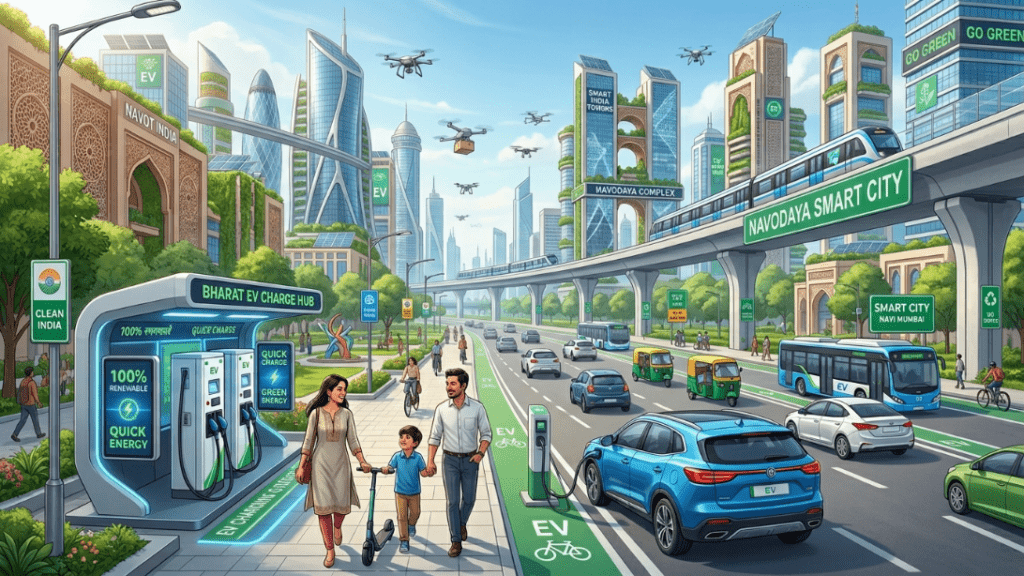
Just two years ago, electric vehicles looked like the golden future of Indian roads. Silent morning drives, dramatically low running costs, zero emissions, cutting-edge technology – everything about EVs sounded like a dream come true for the Indian middle class.
Bollywood celebrities posted Instagram stories from their shiny new electric cars. Tech influencers called petrol cars “outdated dinosaurs.” Government ads promised a cleaner, cheaper tomorrow. The EV revolution was here, and everyone wanted to be part of it.
But here’s what nobody talks about openly: thousands of Indian EV owners are quietly switching back to petrol cars.
Not because they hate the environment. Not because they love spending money on fuel. But because the reality of EV ownership in India turned out to be dramatically different from the glossy advertisements.
What went so wrong?
This isn’t just another EV vs petrol debate. This is the untold story of Indian families who believed in the electric dream, invested their hard-earned money, and discovered some uncomfortable truths about our roads, our infrastructure, and our daily lives.
The Electric Dreams That Captured India
Remember 2022? Petrol prices were touching ₹110 per liter in major cities. Every fuel station visit felt like a financial punch to the gut. Middle-class families were calculating monthly fuel budgets like never before.
Then came the electric vehicle wave.
Tata Nexon EV became the poster child of affordable electric mobility. MG ZS EV brought premium electric features to Indian roads. Mahindra eKUV100 promised city-friendly electric commuting. Even Ola Electric scooters were becoming status symbols among young Indians.
The math looked incredible on paper:
- ₹2-3 per kilometer for EVs vs ₹8-10 for petrol cars
- Government subsidies reducing purchase prices by ₹1-3 lakhs
- Zero emission guilt for environmentally conscious families
- Instagram-worthy silent acceleration that made petrol engines feel ancient
- Modern tech features like smartphone connectivity and over-the-air updates
Social media amplified the excitement. YouTube channels showed dramatic acceleration tests. Car reviewers emphasized fuel cost savings. Government campaigns promoted electric mobility as the future.
The FOMO was real. Everyone wanted to be the smart early adopter who cracked the code of affordable transportation.
Indian Families Started Believing
Rajesh from Pune calculated that his daily 40-kilometer office commute would cost ₹200 in his petrol car but just ₹60 in an electric vehicle. “In one year, I’ll save over ₹50,000,” he told his wife excitedly.
Priya from Bangalore loved the idea of contributing to cleaner air in her already polluted city. “My kids will thank me for this decision,” she thought while booking a test drive.
The emotional appeal was undeniable. EVs represented progress, intelligence, and responsible parenting all rolled into one shiny, silent package.
But emotions don’t charge batteries on empty highways.
The Harsh Reality After the Honeymoon Period
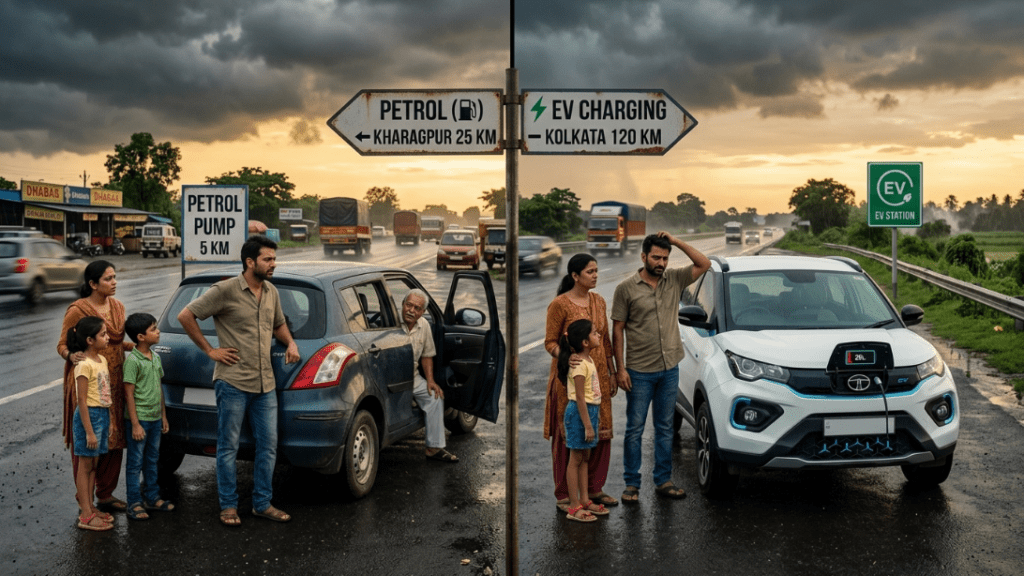
Six months after buying their electric cars, the excitement started fading.
The Instagram posts became less frequent. The bragging about fuel savings turned into quiet conversations about “range anxiety.” The pride of owning cutting-edge technology slowly transformed into daily stress about battery percentages.
Here’s what really happened in Indian homes:
The Charging Station Hunt
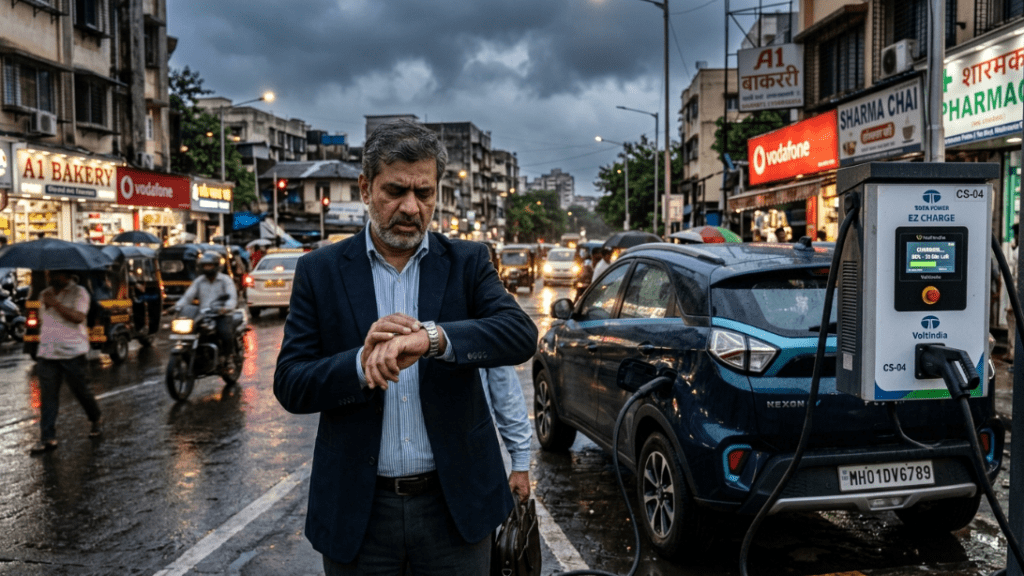
“Where’s the nearest charging station?” became the most googled question among new EV owners.
Unlike the promised network of charging infrastructure, ground reality painted a different picture. Delhi had barely 300 public charging stations for lakhs of vehicles. Mumbai struggled with even fewer reliable options. Smaller cities like Indore or Coimbatore felt like EV deserts.
Weekend road trips – once spontaneous family adventures – became military-style planning operations. “Can we reach Lonavala and back on a single charge?” replaced the simple joy of hitting the road.
The 3 AM Charging Anxiety
Indian EV owners developed a new form of insomnia: battery percentage anxiety.
Unlike petrol cars that could be refueled in 3 minutes anywhere, EVs demanded 4-8 hour charging cycles. For apartment dwellers without dedicated parking, this meant late-night hunts for available charging points.
Ankit from Gurgaon shares: “I used to wake up at 3 AM to move my car from the apartment parking to the nearest charging station. My wife thought I was going crazy.”
The Summer Reality Check
Indian summers exposed another uncomfortable truth about electric vehicle ownership.
When temperatures hit 45°C in states like Rajasthan and Haryana, EVs faced a brutal reality check. Air conditioning – absolutely essential for survival – drained batteries 40-50% faster than advertised ranges.
A 300-kilometer claimed range suddenly became 180 kilometers with AC running full blast. Highway speeds combined with summer heat turned confident morning journeys into afternoon rescue calls to family members.
The Highway Breakdown Drama
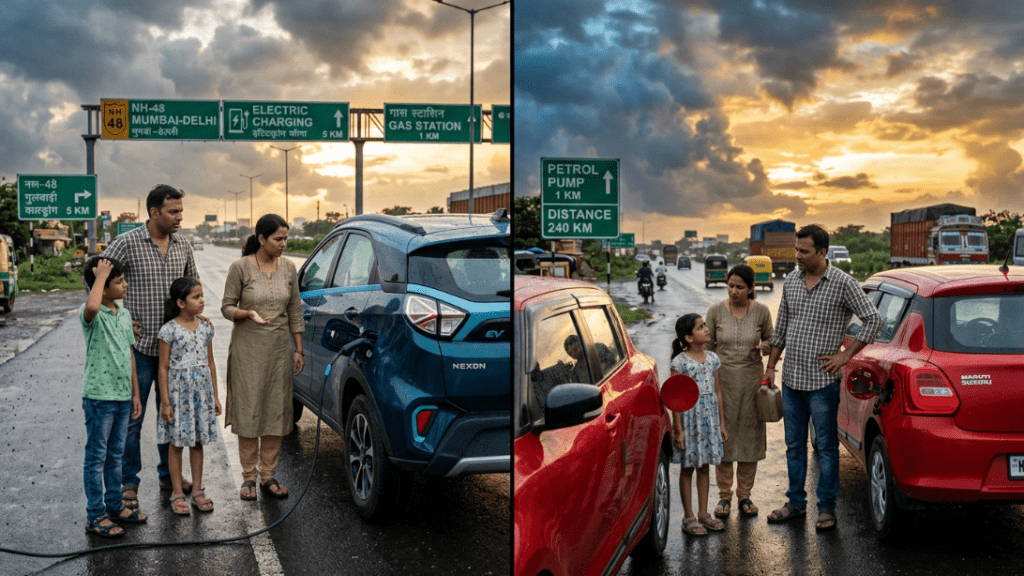
Nothing prepared Indian EV owners for the highway breakdown experience.
When a petrol car runs out of fuel, someone can bring a jerry can and solve the problem in 5 minutes. When an EV runs out of charge on a highway, the options are significantly more dramatic:
- Wait for a specialized EV rescue vehicle (if available)
- Get towed to the nearest charging station
- Call family members for a very awkward pickup
The Mumbai-Pune expressway became particularly notorious among EV owners. Multiple charging stations remained “under maintenance” for months, leaving travelers stranded.
The Biggest Reasons Indians Are Returning to Petrol Cars
1. Fuel Stations Are Still King
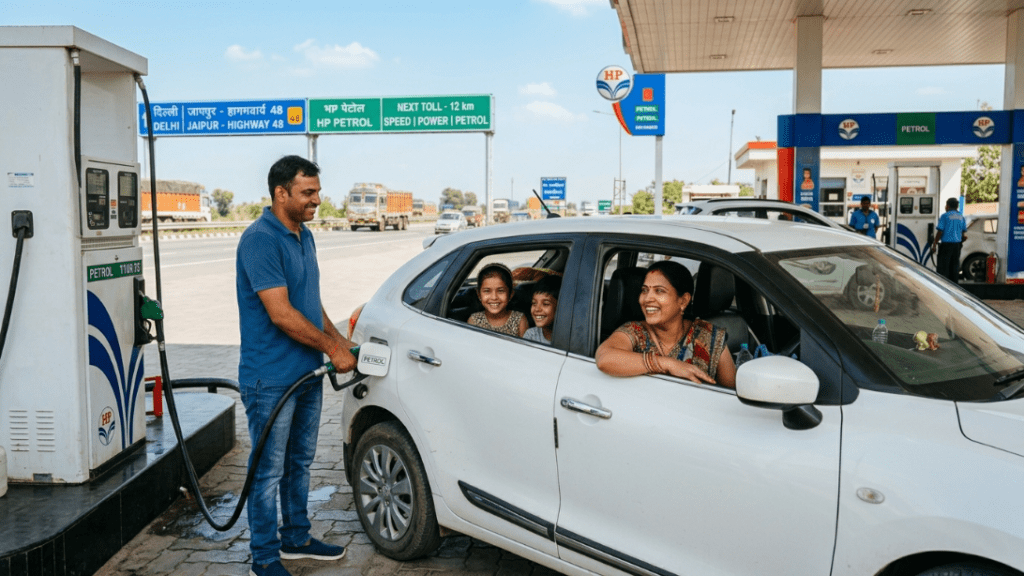
Every 2-3 kilometers on Indian highways, there’s a petrol pump. This basic infrastructure advantage became impossible to ignore for practical families.
Ramesh from Chennai switched back after 8 months: “I realized I was planning my life around charging stations instead of living freely. With my Maruti Swift, I can drive anywhere in Tamil Nadu without a second thought.”
The psychological comfort of knowing fuel is always available proved more valuable than monthly savings for many Indian families.
2. The 3-Minute vs 3-Hour Reality
Refueling a petrol car takes 3 minutes. Charging an EV takes 3-8 hours.
For families juggling work, school pickups, grocery shopping, and social commitments, this time difference became a daily stress factor.
Working mothers found EVs particularly challenging. “I can’t plan my day around charging schedules,” explains Neha from Noida. “With my petrol car, I fuel up and forget about it for a week.”
3. Indian Road Trip Culture
Indians love spontaneous road trips. Weekend drives to hill stations, sudden family emergencies, festival travels – our culture demands transportation flexibility.
EVs introduced a planning rigidity that felt alien to the Indian lifestyle. “Let’s drive to Goa tomorrow” became “Let’s spend three days planning charging stops for our Goa trip.”
4. The Battery Replacement Fear
Perhaps the biggest psychological barrier: the looming fear of battery replacement costs.
While car companies promised 8-year warranties, the thought of potentially paying ₹3-5 lakhs for a battery replacement after warranty period created genuine anxiety among owners.
Petrol engines – familiar, repairable, and trustworthy to most Indians – felt safer for long-term ownership. “I know my mechanic can fix any petrol car problem,” explains Suresh from Hyderabad. “But who fixes EV electronics in my neighborhood?”
5. The Service Center Struggle
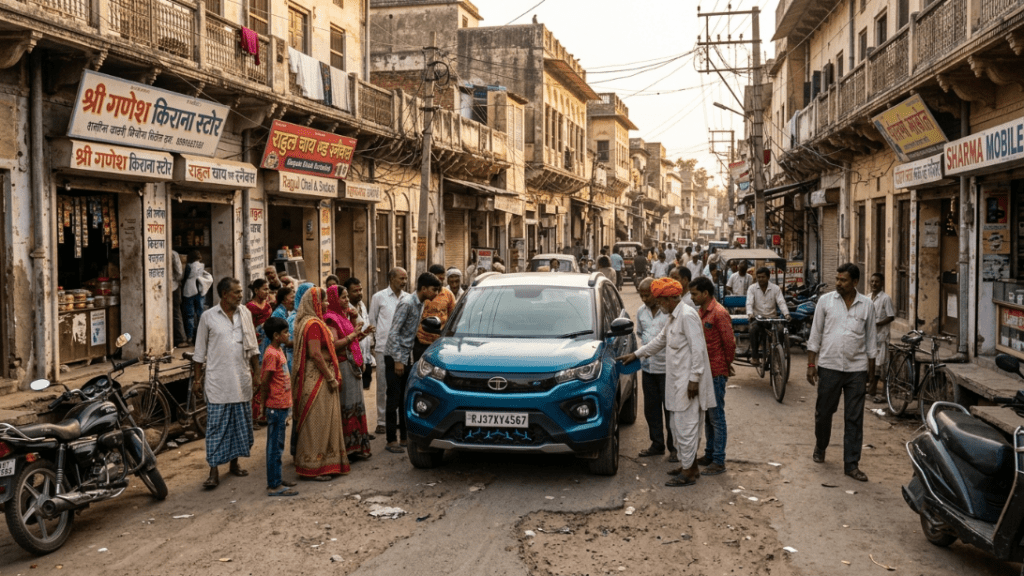
Authorized EV service centers remained concentrated in major cities. For Indian families in Tier-2 and Tier-3 cities, any technical issue meant long journeys to metropolitan areas.
Software glitches, charging port problems, and electronic failures required specialized expertise that local mechanics couldn’t provide.
Meanwhile, petrol car service remained available in virtually every Indian town. The comfort of familiar technology outweighed the excitement of innovation for many practical families.
Real Indian Road Conditions: The EV Challenge
Monsoon Mayhem
Indian monsoons created unexpected challenges for EV ownership.
Flooded roads in cities like Mumbai and Kolkata raised concerns about water damage to expensive EV electronics. While manufacturers claimed waterproofing, many owners felt nervous driving through standing water that petrol car owners navigated confidently.
Power cuts during monsoons – common across India – meant home charging became unreliable exactly when it was needed most.
Traffic Jam Battery Drain
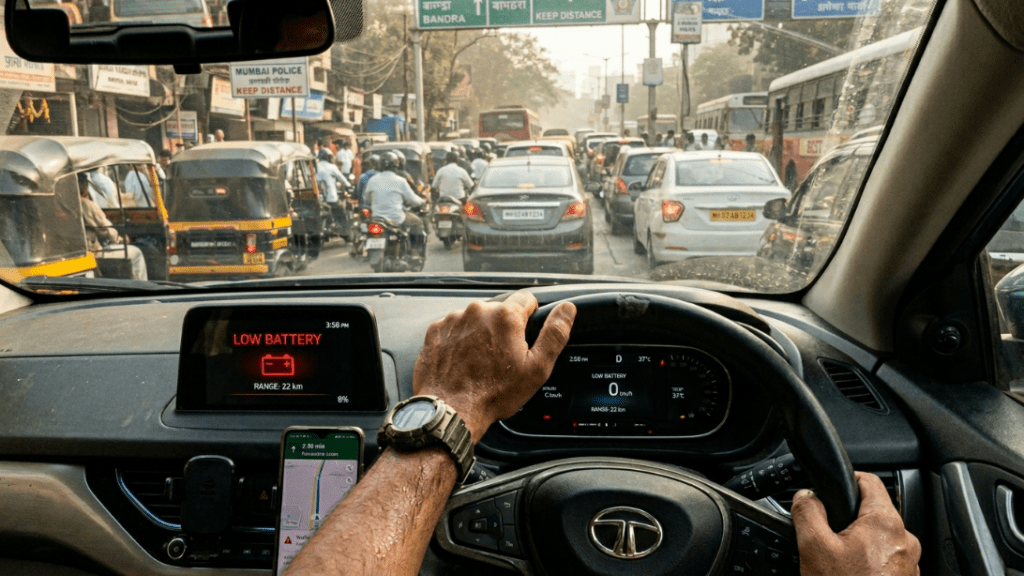
Indian traffic jams are legendary. 2-hour commutes in cities like Bangalore and Delhi meant constant AC usage while crawling at 5 km/h.
This stop-and-go traffic pattern proved particularly draining for EV batteries. Range anxiety became daily anxiety for many urban EV owners stuck in endless traffic.
Apartment Charging Nightmares
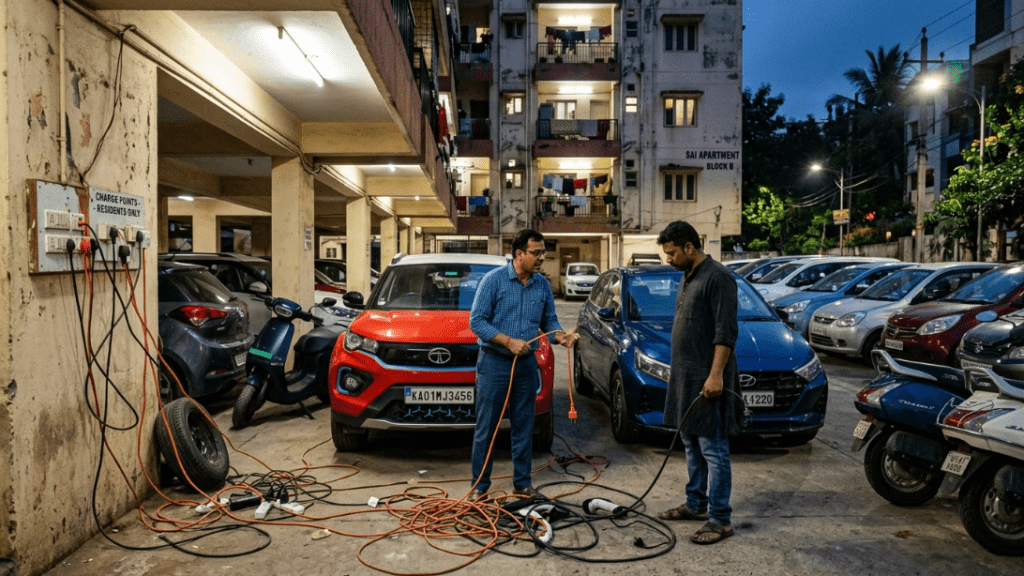
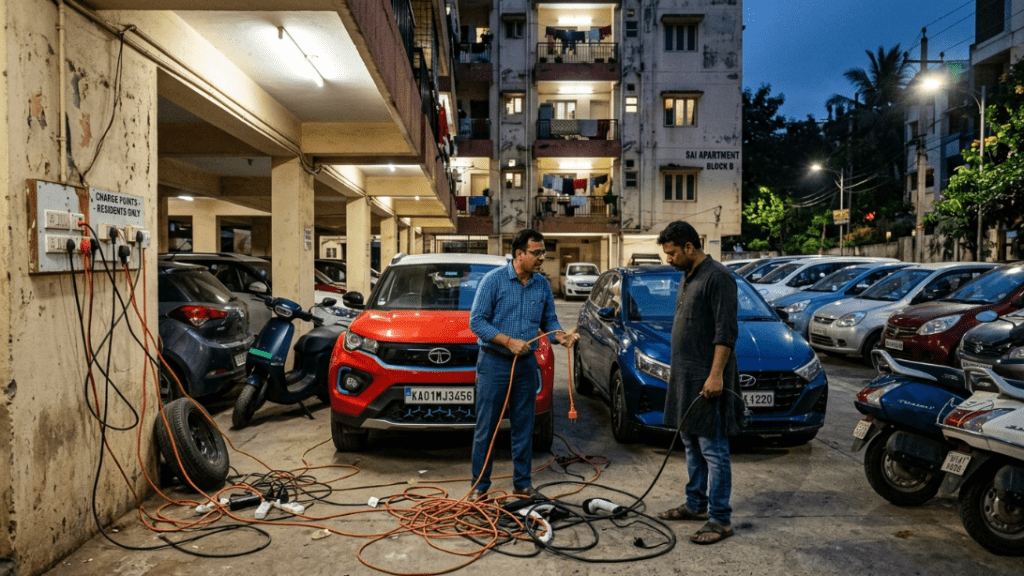
70% of urban Indians live in apartments without dedicated parking spaces. Installing home charging infrastructure became a complex negotiation with housing societies, neighbors, and electricity boards.
Many EV owners resorted to:
- Extension cords running from 4th-floor apartments to parking areas
- Booking charging slots days in advance at public stations
- Charging at office parking (when available)
The convenience factor that made petrol cars attractive remained elusive for most apartment-dwelling EV owners.
Tier-2 City Reality
Indian EV adoption concentrated heavily in metro cities. Smaller cities like Mangalore, Vadodara, or Bhopal had minimal charging infrastructure.
For families planning to keep cars for 10+ years – typical Indian ownership patterns – the uncertainty of infrastructure development in smaller cities influenced purchase decisions toward familiar petrol technology.
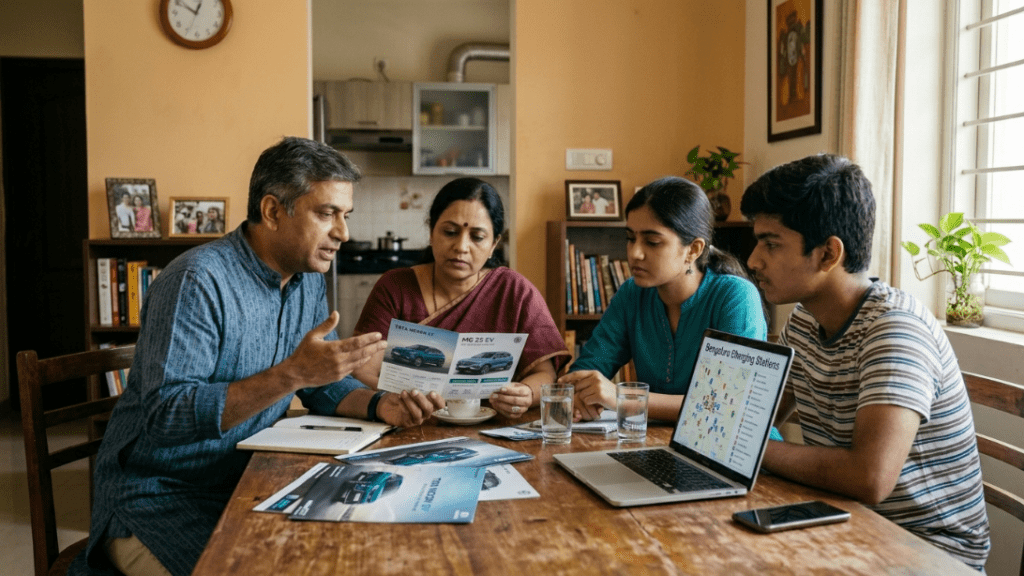
Is the EV Hype Slowing Down in India?
Recent market data suggests a complex picture emerging:
Sales Numbers Tell a Story
2023-2024 EV sales growth slowed compared to explosive 2021-2022 numbers. Initial enthusiasm gave way to careful evaluation among Indian buyers.
Hybrid cars gained significant attention as a middle-ground solution. Toyota Camry Hybrid and Honda City Hybrid attracted buyers seeking fuel efficiency without charging infrastructure dependence.
Consumer Behavior Evolution
Indian buyers became smarter. Test drives extended to week-long experiences. Real ownership reviews on YouTube gained more views than promotional content.
The narrative shifted from “EVs are the future” to “EVs are good for specific use cases.”
Market Maturity
This isn’t necessarily negative for EVs. Markets naturally evolve from hype-driven adoption to practical, informed purchasing decisions.
Indian consumers – traditionally cautious with big-ticket purchases – simply needed more time to evaluate long-term EV ownership realities.
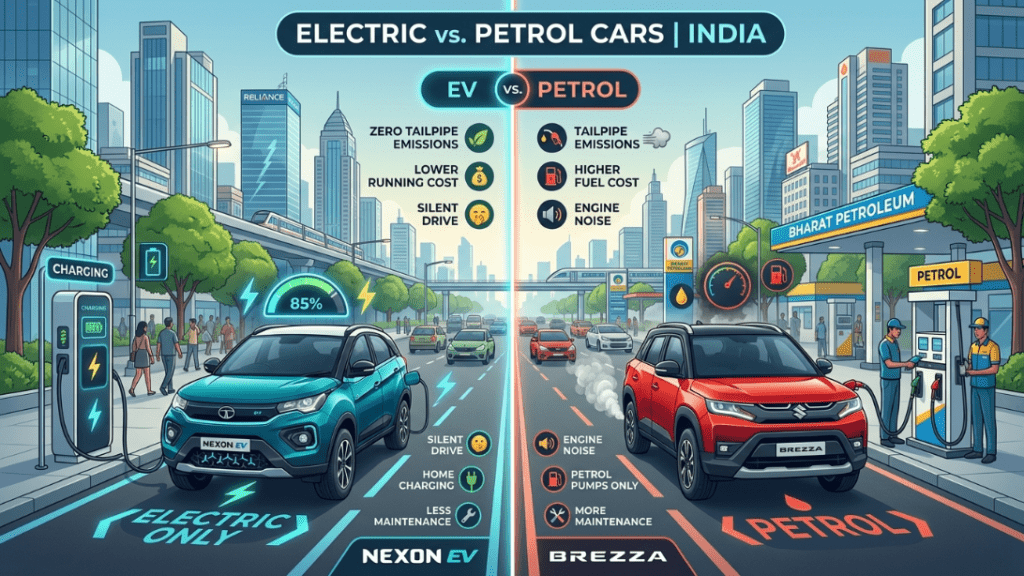
Petrol vs EV: The Brutally Honest Comparison
| Factor | Petrol Cars | Electric Cars | Reality Winner |
|---|---|---|---|
| Daily City Use | Good fuel efficiency | Excellent cost per km | EV wins |
| Highway Travel | Seamless anywhere | Planning required | Petrol wins |
| Refueling Speed | 3 minutes | 3-8 hours | Petrol wins |
| Running Costs | ₹8-12 per km | ₹2-4 per km | EV wins |
| Infrastructure | Everywhere | Limited but growing | Petrol wins |
| Maintenance | Familiar, local | Specialized, expensive | Petrol wins |
| Performance | Good acceleration | Instant torque | EV wins |
| Resale Value | Established market | Unknown trajectory | Petrol wins |
| Environment | Pollution | Zero emissions | EV wins |
| Initial Cost | Lower | Higher (despite subsidies) | Petrol wins |
The Honest Verdict
Neither technology is universally superior. Both serve different Indian lifestyle patterns.
Who Should Still Buy an EV in India?
Electric vehicles make perfect sense for specific Indian users:
The Ideal EV Owner Profile
City commuters with predictable daily routes under 100 kilometers. Software professionals in Bangalore, bankers in Mumbai, government employees in Delhi with fixed office locations.
Families with home charging facilities. Independent houses or premium apartments with dedicated parking and electrical infrastructure.
Second car owners using EVs for daily commuting while keeping petrol cars for weekend travels. This hybrid approach provides both cost savings and flexibility.
Environmental enthusiasts willing to adjust lifestyle patterns for sustainability goals. These buyers prioritize ecological impact over convenience factors.
Short-distance urban families whose longest regular journey is airport runs or shopping mall visits within city limits.

EV Success Stories
Priya from Pune uses her Tata Nexon EV for daily 25-kilometer office commutes. “I charge at home every night and spend ₹3,000 monthly instead of ₹12,000 on fuel. For my usage, EVs are brilliant.”
Tech startup founder Vikram from Hyderabad bought MG ZS EV for city meetings. “I’m saving ₹60,000 annually, and clients are impressed by the technology. Perfect for my business use.”
Who Should Choose Petrol Cars?
Petrol vehicles remain practical for majority Indian families:
The Ideal Petrol Car Owner Profile
Frequent highway travelers. Sales professionals covering multiple states, families with relatives in different cities, business owners making regular long-distance trips.
Single car families needing maximum flexibility. Middle-class households depending on one vehicle for all transportation needs – office, school, emergencies, and entertainment.
Rural and semi-urban families. Tier-3 cities and villages where EV infrastructure development remains uncertain.
Families without home charging options. Apartment dwellers in older buildings without electrical infrastructure for EV charging.
Budget-conscious buyers prioritizing lower upfront costs and established resale markets.
Long-term ownership families. Indians typically keep cars for 8-12 years. Petrol car reliability over extended periods remains proven.
Petrol Car Advantages in Indian Context
Mechanic availability in every Indian town. Spare parts accessibility even in remote areas. Established used car markets for easier resale. Zero range anxiety for spontaneous travel plans.
The Future of EVs in India: A Realistic Timeline
What’s Coming in 2026-2030
Fast charging technology will dramatically improve. 15-30 minute charging to 80% capacity will make highway travel practical.
Battery costs are declining globally. More affordable EVs under ₹10 lakhs will attract budget-conscious Indian families.
Charging infrastructure expansion by NTPC, IOCL, and private players will address current availability concerns.
Indian government’s PLI schemes and state EV policies will accelerate infrastructure development in Tier-2 cities.
Technology Evolution
Solid-state batteries promise longer ranges and faster charging. Vehicle-to-grid technology may turn EVs into home power backup systems – particularly valuable in India.
Hybrid technology will bridge the transition gap. Strong hybrid and plug-in hybrid options will provide EV benefits without infrastructure dependence.
Market Predictions
2030 targets suggest 30% of new car sales could be electric. However, this requires massive infrastructure investment and consumer education.
Regional adoption patterns will vary dramatically. South Indian states with better power infrastructure may lead adoption. Northern states may follow hybrid routes initially.
What India Needs Before Mass EV Adoption
Reliable nationwide charging networks with guaranteed uptime. Apartment charging solutions for urban housing societies. Local EV service expertise in smaller cities.
Battery recycling infrastructure to address environmental concerns. Clear policies on battery replacement costs and extended warranties.
Grid stability improvements to handle increased electrical load from mass EV adoption.

Wheelinity Expert Verdict: The Balanced Truth
After analyzing thousands of real ownership experiences, market data, and ground realities, here’s our editorial stance:
EVs are not failing in India – they’re simply finding their natural market fit.
The early hype cycle created unrealistic expectations among Indian buyers. Every new technology goes through this maturation process. Smartphones faced similar adoption challenges in India before becoming ubiquitous.
For specific use cases, EVs are genuinely superior. For others, petrol cars remain more practical. The mistake was assuming one size fits all in diverse India.
Our recommendation: Buy based on your actual usage patterns, not future possibilities or environmental guilt.
If your daily driving is under 100 kilometers with home charging access, EVs offer genuine benefits. If you’re a highway warrior or live in a smaller city, petrol cars provide better peace of mind.
The future belongs to choice, not mandates. Smart Indian consumers are making informed decisions rather than emotional ones. This market maturity is actually healthy for both EV and petrol car segments.
Conclusion: The Real Winner in India’s Auto Evolution
The story of Indian EV owners switching back to petrol cars isn’t a tale of technological failure. It’s a story of market evolution, consumer education, and the complex realities of a diverse nation.
Every family switching back taught us valuable lessons about infrastructure needs, usage patterns, and practical requirements. Every family staying with EVs proved the technology works brilliantly in specific contexts.
The real winner isn’t petrol or electric – it’s choice.
For the first time in decades, Indian consumers have genuine alternatives. Budget EVs, premium electrics, efficient petrol cars, hybrid technology – the options have never been richer.
Some families need the reliability of petrol. Others thrive with electric efficiency. Many will choose hybrids as the perfect middle ground. All these decisions are valid.
The future of Indian mobility isn’t about picking winners and losers. It’s about having the right vehicle for every lifestyle, every budget, and every dream.
Whether you choose electric, petrol, or hybrid – choose based on your reality, not someone else’s vision of the future.
The road ahead has space for everyone.
FAQ Section
Q1: Are EVs really saving money for Indian families?
A: For city commuters driving 30-50 km daily with home charging, EVs save ₹40,000-60,000 annually. However, families doing frequent long-distance travel may not see significant savings due to fast-charging costs and time inefficiencies.
Q2: What’s the biggest problem with EVs in India?
A: Charging infrastructure reliability and time requirements. Unlike petrol stations available every 2-3 km, EV charging stations are limited, often non-functional, and require 4-8 hours for full charging.
Q3: Should I wait for better EV technology before buying?
A: If you’re a city commuter with home charging access, current EVs work well. If you need maximum flexibility or live in smaller cities, waiting 2-3 years for better infrastructure and faster charging technology makes sense.
Q4: Are petrol cars becoming outdated in India?
A: No. Petrol cars remain practical for majority Indian usage patterns – highway travel, single-car families, and areas with limited charging infrastructure. Both technologies will coexist for the next decade.
Q5: Which cities are best for EV ownership in India?
A: Delhi-NCR, Bangalore, Mumbai, Pune, and Hyderabad have the best charging infrastructure and service networks. Chennai, Ahmedabad, and Kolkata are catching up. Tier-2 cities still need significant infrastructure development.