
Tesla vs BYD: Which EV Brand Is Better in 2026?
The Battle That’s Redefining Electric Mobility
Tesla vs BYD is one of the most searched electric vehicle comparisons in 2026. Tesla continues to lead with advanced software, fast charging, and strong performance, while BYD dominates global EV sales with affordable pricing, innovative Blade Battery technology, and a rapidly expanding lineup. In this Tesla vs BYD comparison, we’ll analyze design, battery technology, range, charging infrastructure, features, pricing, and ownership experience to help you decide which EV brand is right for you.
Buckle up. This isn’t your typical brand comparison. This is a deep dive into battery wars, software supremacy, design philosophy, and the future of mobility itself.
By the end of this article, you’ll know exactly which EV brand deserves a spot in your driveway.
Let’s get electric.
| Feature | Tesla | BYD |
|---|---|---|
| Battery | 4680 Cells | Blade Battery |
| Range | Up to 405 mi | Up to 376 mi |
| Charging | Faster | Good |
| Software | Excellent | Good |
| Price | Higher | Lower |
Also Read This
Things To Know Before Buying An Electric Car
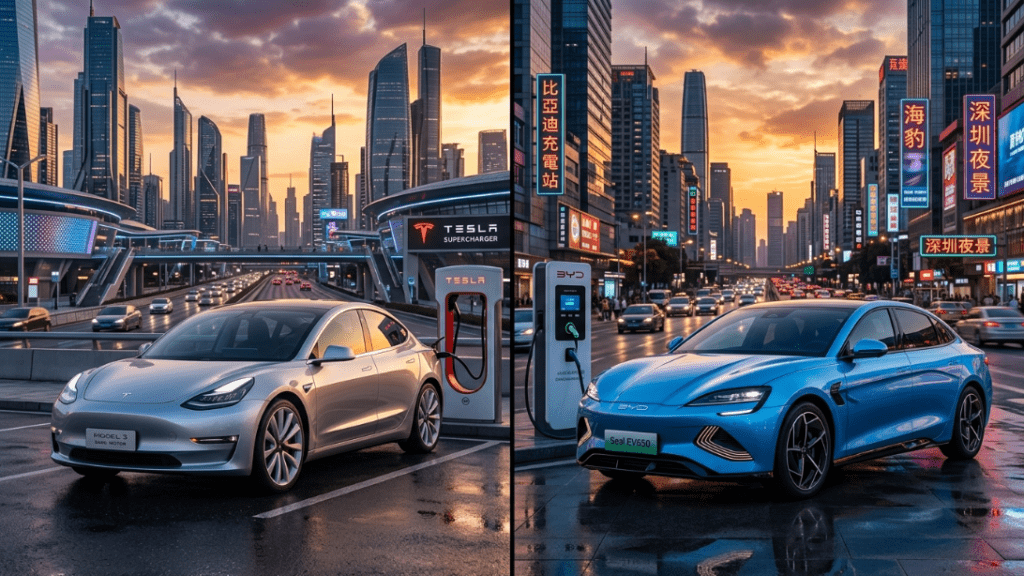
Tesla vs BYD: Brand Overview
The Brand That Made EVs Cool
Remember when electric cars were boring golf carts? Tesla doesn’t.
Since 2008, Tesla has been the poster child of electric revolution. From the game-changing Roadster to the mass-market Model 3, Elon Musk’s brainchild turned EVs into status symbols.
What Tesla Stands For in 2026:
- Innovation-first mentality (sometimes to a fault)
- Cutting-edge autonomous driving technology
- Supercharger network that still dominates globally
- Premium pricing with premium performance
- Over-the-air updates that keep cars fresh for years
Tesla isn’t just selling cars. It’s selling a vision of the future—one where robots drive you, energy is sustainable, and your car is basically a computer on wheels.
Tesla’s 2026 Lineup Highlights
- Model 3 Highland: Refined, minimalist, and crazy efficient
- Model Y: The world’s best-selling EV (again)
- Cybertruck: Finally in full production (yes, really)
- Model S Plaid: Still the fastest production sedan on earth
- Roadster 2.0: Teased… again
BYD: The Silent Giant You Underestimated
From Batteries to Domination
BYD (Build Your Dreams) didn’t just enter the EV game. It invented the battery game.
Founded in 1995 as a battery manufacturer, BYD has been making batteries longer than Tesla has been making cars. And in 2024, it officially overtook Tesla as the world’s top EV seller.
Let that sink in.
What BYD Stands For in 2026:
- Vertical integration mastery (they build EVERYTHING in-house)
- Blade Battery technology that’s safer and longer-lasting
- Affordable EVs for the masses
- Expanding global footprint (Europe, Asia, Latin America, Middle East)
- Diverse range: sedans, SUVs, buses, trucks, even monorails
BYD’s strategy? Don’t just compete with Tesla. Outproduce, underprice, and out-engineer everyone.
BYD’s 2026 Lineup Highlights
- Seal: Tesla Model 3 killer with ocean-themed design
- Atto 3: Compact SUV dominating global markets
- Han EV: Luxury sedan rivaling Model S
- Dolphin: Affordable city car under $20,000
- Tang EV: 7-seater family SUV with serious power
- Yangwang U8: Ultra-luxury off-roader with tank-turn mode
Tesla vs BYD Design Comparison
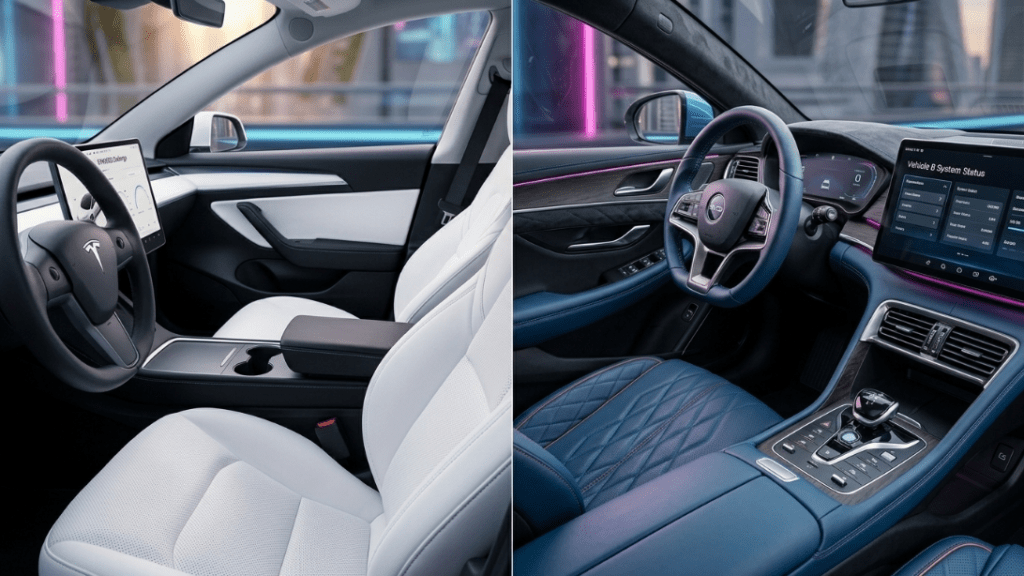
Tesla vs BYD Design: Tesla’s Design Language
Clean. Minimalist. Polarizing.
Tesla’s design philosophy hasn’t changed much: reduce everything to its essence. No grilles (because no engine). No buttons (everything’s on a screen). No BS.
The Model 3 Highland epitomizes this—ambient lighting, premium materials, but still that controversial yoke steering wheel option.
Love it or hate it, Tesla’s design is instantly recognizable.
Pros:
- Timeless minimalism
- Aerodynamic efficiency
- Tech-forward interiors
Cons:
- Lack of physical buttons frustrates many
- Build quality inconsistencies (panel gaps, anyone?)
- Design language feels repetitive across models
Tesla vs BYD Design: BYD’s Design Language
Bold. Practical. Surprisingly Premium.
BYD’s design has evolved dramatically. Early models looked… uninspired. But 2026 BYD? It’s giving Audi vibes at Toyota prices.
The Seal and Han feature flowing curves, dragon-face grilles, and interiors that blend digital tech with physical controls—something many drivers actually prefer.
BYD also offers variety—from cute city cars (Dolphin) to rugged luxury SUVs (Yangwang U8).
Pros:
- Diverse design language across models
- Better build quality than ever
- Mix of screens + physical buttons (more intuitive)
Cons:
- Less brand identity consistence
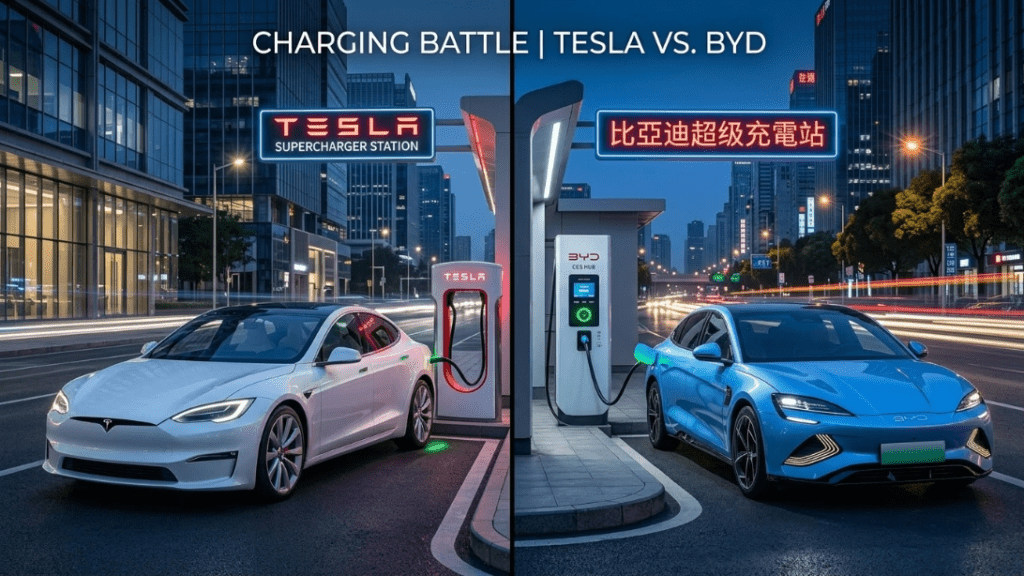
Design Comparison Table
| Aspect | Tesla | BYD |
|---|---|---|
| Design Philosophy | Minimalist, tech-first | Practical, evolving premium |
| Interior Style | Screen-dominated, buttonless | Balanced digital + physical |
| Build Quality | Improving but inconsistent | Consistently solid |
| Brand Recognition | Instantly identifiable | Growing but varied |
| Wow Factor | High (Cybertruck) | Moderate (Yangwang U8) |
Tesla vs BYD Battery Technology
This is where things get seriously technical—and seriously important.
Tesla vs BYD Battery Comparison: Tesla’s Battery Strategy
Tesla uses lithium-ion batteries (primarily NCA and LFP chemistries) sourced from partners like Panasonic, LG, and CATL.
2026 Tesla Battery Highlights:
- 4680 cells: Larger format, better energy density, faster charging
- Structural battery packs: Chassis integration for weight reduction
- LFP for base models: Cheaper, longer-lasting (but less range)
- NCA for performance models: Higher energy density
Tesla’s advantage? Software-driven battery management that squeezes every electron for maximum range.
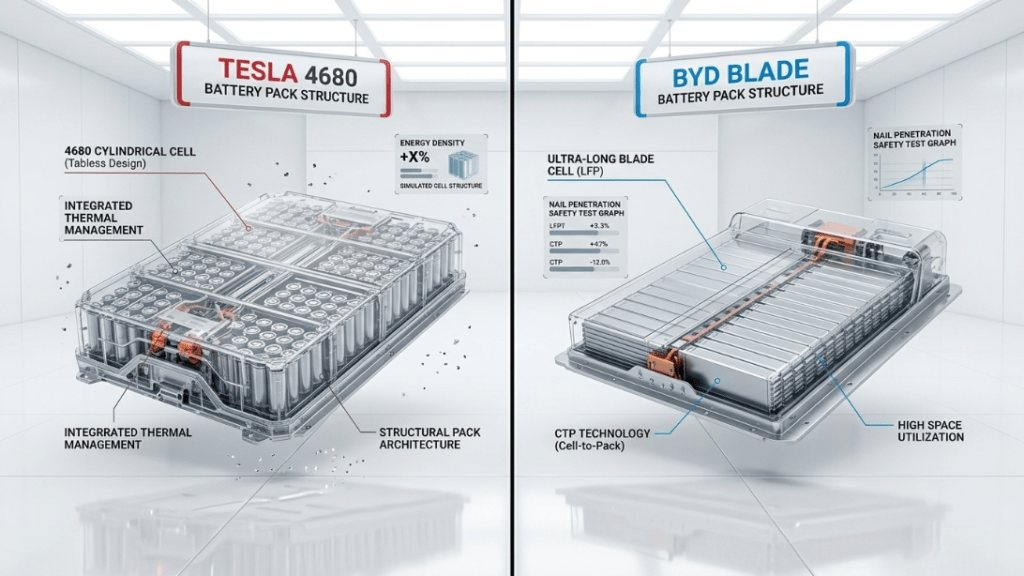
Battery Range (2026 estimates):
- Model 3 Long Range: ~358 miles (576 km)
- Model Y Long Range: ~330 miles (531 km)
- Model S Long Range: ~405 miles (652 km)
Tesla vs BYD Battery Comparison: BYD’s Blade Battery
Here’s where BYD flexes.
The Blade Battery (lithium iron phosphate or LFP) is BYD’s crown jewel. It’s:
- Safer: Passed the nail penetration test (no fire/explosion)
- Longer-lasting: 1 million km lifespan potential
- More space-efficient: 50% more energy density than traditional LFP
- Cheaper to manufacture: No cobalt needed
BYD also has the e-Platform 3.0, which integrates battery, motor, and electronics for efficiency.
Battery Range (2026 estimates):
- BYD Seal: ~342 miles (550 km)
- BYD Han: ~376 miles (605 km)
- BYD Atto 3: ~261 miles (420 km)
The Verdict?
Tesla has better energy density in performance models. BYD has safer, cheaper, longer-lasting batteries. Both are winning in different ways.
Battery Tech Comparison Table
| Feature | Tesla | BYD |
|---|---|---|
| Battery Type | NCA, LFP (4680 cells) | Blade Battery (LFP) |
| Safety | Good | Exceptional (nail test passed) |
| Lifespan | 300,000-500,000 miles | 600,000+ miles |
| Charging Speed | Up to 250 kW | Up to 150 kW (improving) |
| Cost | Higher (NCA models) | Lower (LFP chemistry) |
| Energy Density | Higher (NCA) | Competitive (Blade) |

Tesla vs BYD Performance and Driving Experience
Tesla vs BYD Performance: Tesla
Holy acceleration, Batman.
Tesla’s performance credentials are legendary:
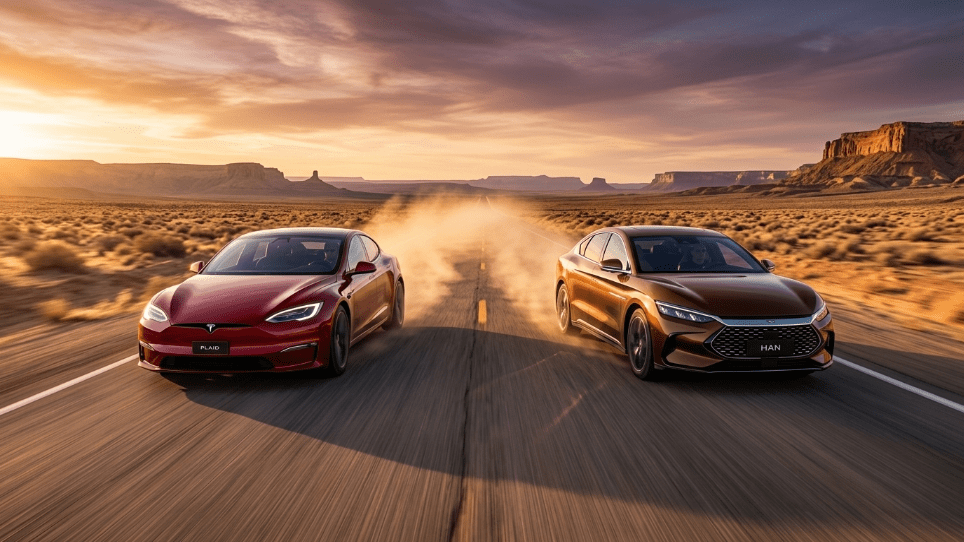
- Model S Plaid: 0-60 mph in 1.99 seconds (yes, really)
- Model 3 Performance: 0-60 in 3.1 seconds
- Track Mode: For amateur racers
- Ludicrous acceleration that pins you to your seat
Tesla’s driving feel? Digital precision. Instant torque. Sharp handling. But some complain about the stiff ride and lack of “driving soul.”
Tesla vs BYD Performance: BYD
Surprisingly capable.
BYD isn’t chasing 0-60 records. They’re chasing real-world usability.
- BYD Han: 0-60 in 3.9 seconds (dual-motor)
- BYD Seal: 0-60 in 3.8 seconds (AWD Performance)
- BYD Tang: 0-60 in 4.6 seconds (7-seater SUV!)
BYD’s driving experience emphasizes comfort, refinement, and quiet cabins. Think Lexus smoothness, not BMW sportiness.
Performance Comparison Table
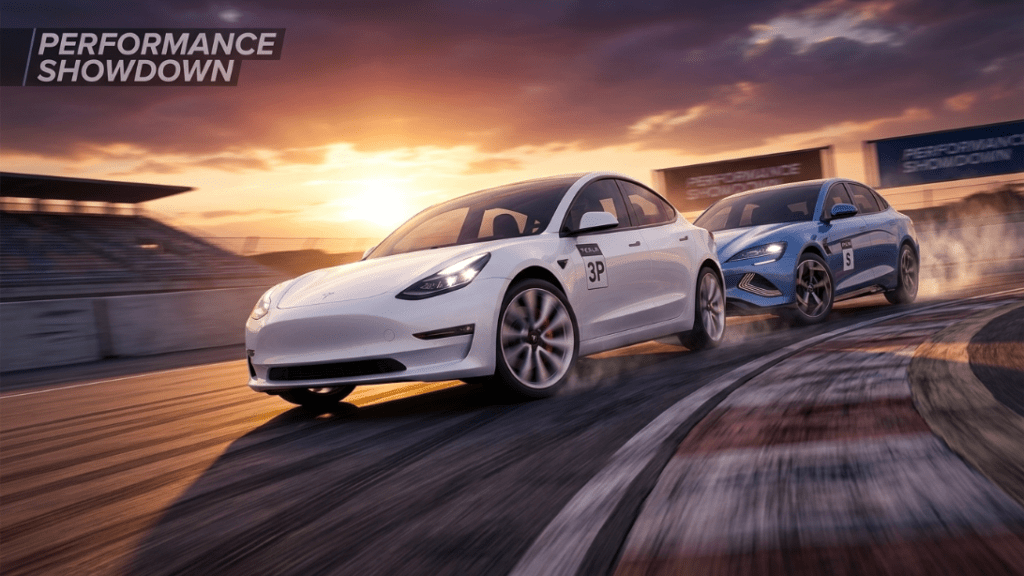
| Metric | Tesla Model 3 Performance | BYD Seal Performance |
|---|---|---|
| 0-60 mph | 3.1 seconds | 3.8 seconds |
| Top Speed | 162 mph | 112 mph |
| Driving Feel | Sharp, sporty | Smooth, comfortable |
| Handling | Excellent | Good |
| Ride Comfort | Stiff | Plush |
Tesla vs BYD Features and Technology
Tesla’s Tech Arsenal
Tesla’s software advantage is real—and it’s massive.
Standout Features (2026):
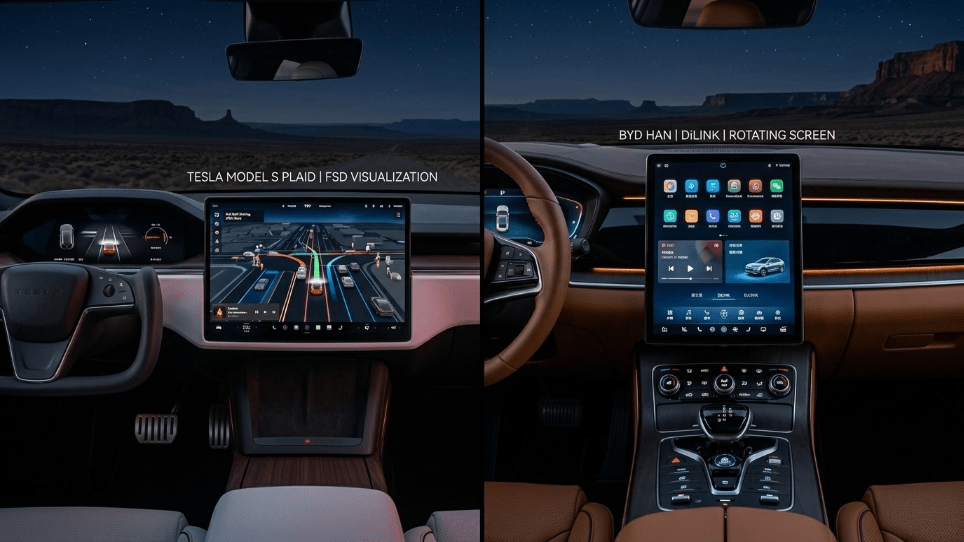
- Full Self-Driving (FSD) v13: Enhanced Autopilot with city driving capability (still needs supervision)
- Neural network-based vision: No LiDAR, pure AI cameras
- OTA updates: Your car literally improves while you sleep
- Entertainment: Gaming, Netflix, Spotify, YouTube
- Sentry Mode: 360° camera surveillance
- Dog Mode: Keep pets comfy while you shop
Tesla’s infotainment is fast, intuitive, but minimalist to a fault (some miss Apple CarPlay).
BYD’s Tech Approach
BYD is catching up fast.
Standout Features (2026):
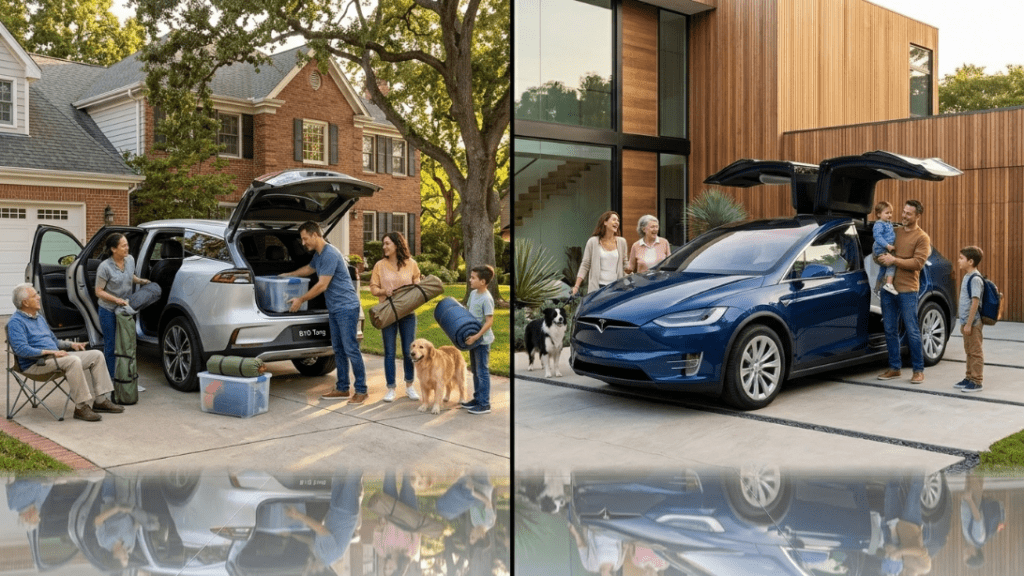
- DiPilot ADAS: Level 2+ autonomous driving with LiDAR on premium models
- Rotating center screens: Portrait/landscape flexibility (loved by users)
- DiLink ecosystem: App store, voice assistant, smart home integration
- Apple CarPlay & Android Auto: Yes, they include both
- Karaoke mode: Because why not?
BYD’s tech feels more user-friendly and less forced than Tesla’s all-screen approach.
Tech Features Comparison Table
| Feature | Tesla | BYD |
|---|---|---|
| Autonomous Driving | FSD (Level 2+, camera-only) | DiPilot (Level 2+, LiDAR option) |
| OTA Updates | Yes (industry-leading) | Yes (growing) |
| Screen Quality | Excellent (15-17″) | Excellent (rotating available) |
| Apple CarPlay | No | Yes |
| Voice Assistant | Good | Improving |
| Entertainment | Superior | Competitive |
Tesla vs BYD Price Comparison
Tesla Pricing (2026 USA Market)
- Model 3 RWD: $42,990
- Model 3 Long Range: $49,990
- Model 3 Performance: $54,990
- Model Y RWD: $47,990
- Model Y Long Range: $52,990
- Model S: $89,990
- Model X: $99,990
Tesla = Premium pricing. You’re paying for brand, performance, and software.
BYD Pricing (2026 Global Markets)
- Dolphin: $18,990
- Atto 3: $27,990
- Seal: $32,990
- Han: $38,990
- Tang: $41,990
BYD = Value champion. More car for less money. Period.
Important note: BYD isn’t officially in the USA yet (2026), but global pricing shows 20-40% savings over Tesla equivalents.
Price Comparison Table
| Segment | Tesla | BYD | Price Difference |
|---|---|---|---|
| Compact Sedan | Model 3 ($42,990) | Seal ($32,990) | BYD -23% cheaper |
| Compact SUV | Model Y ($47,990) | Atto 3 ($27,990) | BYD -42% cheaper |
| Luxury Sedan | Model S ($89,990) | Han ($38,990) | BYD -57% cheaper |
Tesla vs BYD Charging and Range
Tesla Supercharger Network
Tesla’s killer advantage.
With 50,000+ Superchargers globally (2026), Tesla’s charging infrastructure is unmatched.
- V4 Superchargers: 250-350 kW speeds
- Plug-and-charge: No apps, no hassle
- Strategic placement: Highways, cities, destinations
- Reliability: 99%+ uptime
If you road trip often, Tesla wins by default.
BYD Charging Reality
BYD relies on third-party networks—which is both good and bad.
- Compatible with CCS/CHAdeMO standards (depending on market)
- Growing partnerships with Electrify America, Ionity, Shell Recharge
- Slower charging speeds (150 kW max on most models)
- Home charging is primary focus
For city drivers? No problem. For road warriors? Tesla has the edge.
Charging Comparison Table
| Aspect | Tesla | BYD |
|---|---|---|
| Charging Network | Proprietary Supercharger (50k+ globally) | Third-party (CCS/CHAdeMO) |
| Max Charging Speed | 250-350 kW | 150 kW |
| Charging Time (10-80%) | ~18-27 minutes | ~30-45 minutes |
| Network Reliability | Excellent | Varies by provider |
| Home Charging | Yes | Yes |
Which Brand Is Better for Different Buyers?
Tesla Is Better If You Want:
✅ Cutting-edge autonomous driving tech
✅ Industry-leading charging infrastructure
✅ Fastest acceleration and performance
✅ Premium brand cachet
✅ Best software and OTA updates
✅ To be an early adopter
Best for: Tech enthusiasts, performance lovers, North American buyers, road trippers
BYD Is Better If You Want:
✅ Best value for money
✅ Safer, longer-lasting Blade Battery
✅ More traditional car features (buttons, CarPlay)
✅ Family-friendly variety (7-seaters, compact cars)
✅ Better build quality at lower price
✅ Practical daily driving comfort
Best for: Budget-conscious buyers, families, Asian/European/Latin American markets, city commuters
India & Global Market Perspective
For Indian Buyers
BYD has the edge (for now).
- Already selling Atto 3 and Seal in India
- More affordable pricing suits Indian market
- Expanding local assembly (lower costs)
- Better suited for Indian road conditions
Tesla is still absent from India in 2026 (import duties and factory negotiations continue).
For Global Buyers
It’s market-dependent:
- USA/Canada: Tesla (infrastructure + brand)
- Europe: Tight race (BYD expanding fast)
- China: BYD dominates
- Southeast Asia: BYD leads
- Middle East: Both growing
- Australia: Tesla currently ahead
Tesla Pros & cons
✅ Pros
- Industry-best autonomous driving technology
- Unmatched Supercharger network
- Exceptional performance and acceleration
- Regular OTA software updates
- Strong resale value
- Premium brand image
- Innovative features (Sentry Mode, Dog Mode)
❌ Cons
- Higher pricing across lineup
- Inconsistent build quality (panel gaps)
- Minimalist interior polarizes buyers
- No Apple CarPlay/Android Auto
- Customer service can be hit-or-miss
- Yoke steering wheel (optional but controversial)
BYD: Pros & Cons
✅ Pros
- Exceptional value for money
- Safer, longer-lasting Blade Battery
- Diverse model range (something for everyone)
- Better build quality than expected
- Includes CarPlay/Android Auto
- Comfortable, refined ride quality
- Vertical integration = cost advantages
❌ Cons
- Slower charging speeds
- Less advanced autonomous driving
- Brand awareness still growing in Western markets
- Software ecosystem not as refined
- Resale value uncertain (newer brand)
- Not available in all markets (USA notably absent)
Tesla vs BYD Final Verdict
There is no universal winner.
Shocked? Don’t be.
Choose Tesla if:
You value performance, cutting-edge tech, and have the budget for premium. You road trip frequently. You want the “iPhone of cars.”
Choose BYD if:
You want maximum value, family-friendly options, and proven battery safety. You primarily city-drive. You prefer practical over flashy.
The honest truth?
Tesla is the aspirational choice—the brand you buy to make a statement.
BYD is the rational choice—the brand you buy because it makes perfect sense.
Both are reshaping the EV landscape. Both have millions of happy customers.
The real winner? You—because competition drives innovation, and innovation drives better, cheaper EVs for everyone.
Frequently Asked Questions (FAQs)
1. Is BYD better than Tesla in 2026?
It depends on priorities. BYD offers better value, safer batteries, and more variety. Tesla offers superior performance, tech, and charging infrastructure. For budget-conscious buyers, BYD wins. For tech enthusiasts, Tesla wins.
2. Which has better battery technology: Tesla or BYD?
BYD’s Blade Battery is safer and lasts longer (LFP chemistry, nail test passed, 1 million km lifespan). Tesla’s NCA batteries offer higher energy density for performance models. Both excel differently.
3. Can you buy BYD cars in the USA in 2026?
Not yet. BYD hasn’t officially entered the US passenger car market as of 2026, though they sell electric buses. High tariffs and regulatory hurdles remain. Focus is on Europe, Asia, and Latin America.
4. Is Tesla’s Full Self-Driving better than BYD’s DiPilot?
Yes, currently. Tesla’s FSD is more advanced (camera-based neural networks, more autonomous features). BYD’s DiPilot is capable Level 2+ ADAS but less sophisticated. However, BYD uses LiDAR on premium models for better reliability.
5. Which EV brand has better resale value?
Tesla has stronger resale value currently due to brand recognition and demand. BYD’s resale market is still developing in Western markets but strong in China.
6. How does BYD sell more EVs than Tesla?
Volume and variety. BYD sells everything from $15,000 city cars to luxury SUVs, electric buses, and trucks. They dominate China (world’s largest EV market) and are expanding globally with affordable models.
7. Which is more reliable: Tesla or BYD?
BYD has fewer reported quality issues overall. Tesla has faced criticism for inconsistent build quality (panel gaps, paint issues). However, both have generally reliable powertrains.
8. Does BYD use Tesla technology?
No. BYD develops its own battery tech (Blade Battery), motors, software (DiLink), and platforms (e-Platform 3.0). They’re vertically integrated and don’t license Tesla tech.
9. Which charges faster: Tesla or BYD?
Tesla charges faster. Superchargers V4 deliver 250-350 kW; Tesla vehicles can handle it. BYD models max out around 150 kW. Tesla’s 10-80% charge takes ~18-27 min vs BYD’s ~30-45 min.
10. Should I wait for next-gen models from Tesla or BYD?
EVs improve constantly. If you need a car now, buy now (both brands offer excellent current models). If you can wait, Tesla’s next-gen platform and BYD’s solid-state battery developments (late 2020s) could be worth it.
Conclusion: Your Electric Future Starts Now
The Tesla vs BYD battle isn’t about declaring a knockout winner.
It’s about recognizing that the EV revolution has two different but equally valid approaches:
Tesla’s innovation-at-any-cost philosophy that pushes boundaries.
BYD’s practical, scalable, affordable strategy that electrifies the masses.
One made EVs desirable. The other made them accessible.
Whichever brand you choose, you’re voting for a cleaner, smarter, more exciting automotive future.