
Best 15 Hacks to Improve Car Mileage in 2026 — Fuel-Saving Tips Every Indian Driver Must Know
Introduction
Fuel prices continue to rise across India, making fuel efficiency more important than ever. If you’re looking to improve car mileage, small changes in driving habits and vehicle maintenance can make a significant difference. In this guide, we’ll cover 15 proven fuel-saving hacks that can help petrol, diesel, hybrid, and CNG vehicle owners get more kilometres from every litre of fuel in 2026.
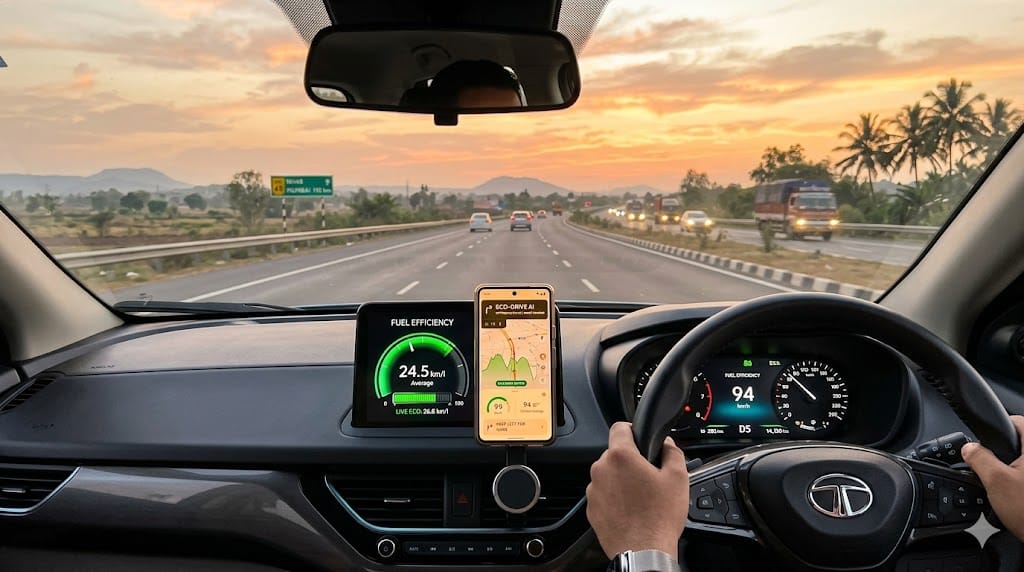
Table of Contents
- Maintain the Right Tyre Pressure
- Use the Correct Engine Oil Grade
- Master Eco-Driving Techniques
- Switch to a Higher Gear Early
- Avoid Aggressive Acceleration and Braking
- Use AI-Based Fuel Monitoring Apps
- Keep Your Air Filter Clean
- Plan Smarter Routes
- Reduce Unnecessary Load
- Service Your Car on Schedule
- Use Cruise Control on Highways
- Park in the Shade
- Upgrade to Low-Rolling-Resistance Tyres
- Keep the AC Use Optimised
- Adopt Hypermiling Habits
Pro Tips Section
Common Mileage Mistakes to Avoid
FAQ Section
Conclusion
Hack #1 — How Correct Tyre Pressure Helps Improve Car Mileage
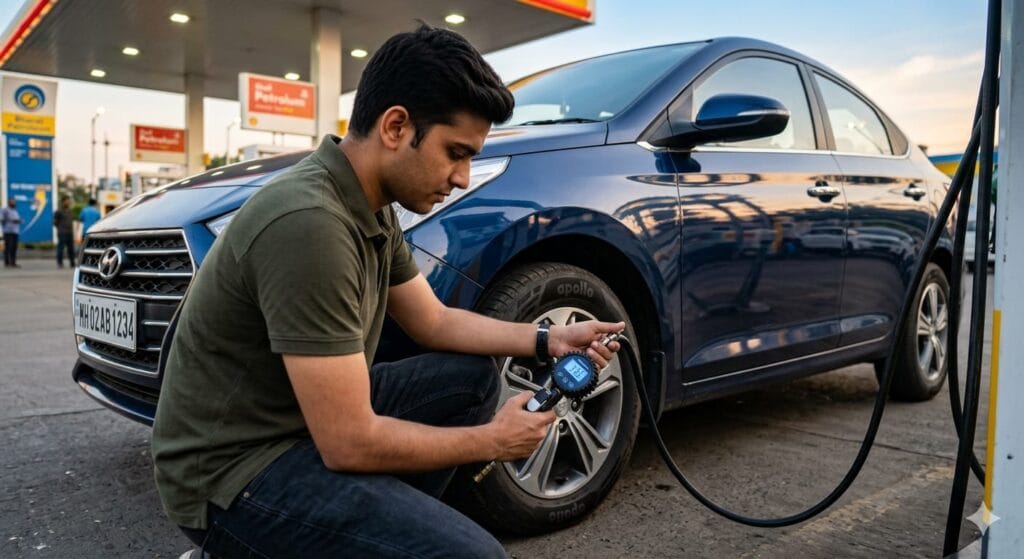
This is the single easiest win available to every car owner, and it’s almost universally ignored.
Under-inflated tyres create more contact with the road surface, which increases rolling resistance and forces the engine to work harder. According to data from the Bureau of Energy Efficiency (BEE) India, under-inflated tyres can reduce fuel efficiency by 0.5% for every 1 PSI drop in pressure — and most Indian cars are running 5–10 PSI below recommended levels.
Quick action: Check your tyre pressure every two weeks and before any highway trip. The recommended PSI is usually printed inside the driver’s door frame or in your owner’s manual.
- Petrol cars: Gain up to 3–4% better mileage
- Diesel SUVs: Particularly noticeable improvement in highway FE
- CNG cars: Correct pressure offsets the slightly heavier CNG tank weight
Use a digital tyre pressure gauge — they cost under ₹500 and pay for themselves within days.
Hack #2 — Use the Correct Engine Oil Grade
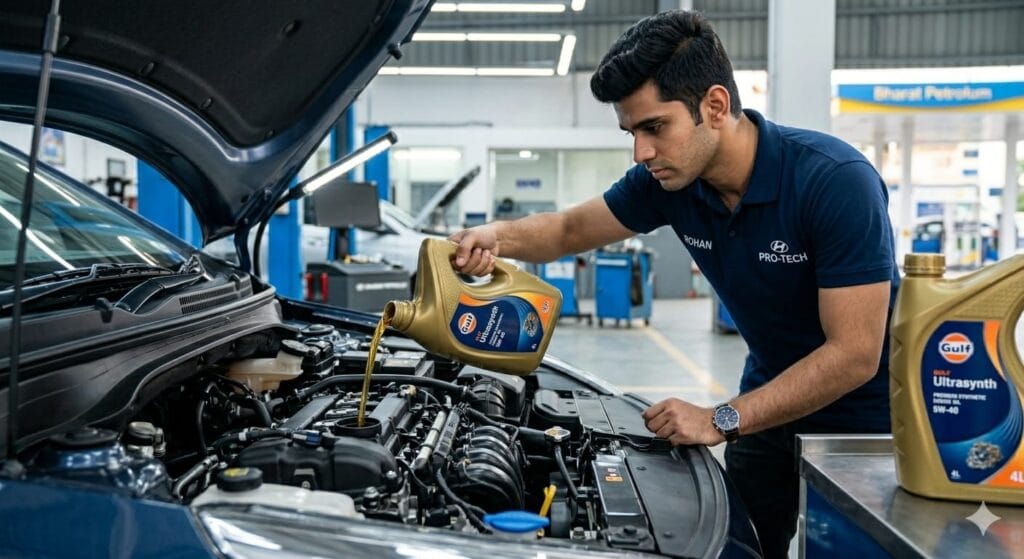
Not all engine oils are created equal. Using a thicker oil than recommended by your manufacturer creates internal friction that silently drains fuel efficiency.
In 2026, most modern petrol engines — including the popular Maruti Suzuki Swift, Hyundai i20, and Tata Altroz — recommend 0W-20 or 5W-30 synthetic oils. These low-viscosity oils flow faster at cold start-up, reducing engine strain significantly.
Real-world impact: Switching from mineral oil to a recommended full-synthetic can improve mileage by 2–3%, which, over 15,000 km/year, translates to roughly 1.5–2 full tanks of fuel saved.
Also, stick to your oil change intervals. Degraded oil thickens, loses lubricity, and hammers fuel economy.
Hack #3 — Master Eco-Driving Techniques
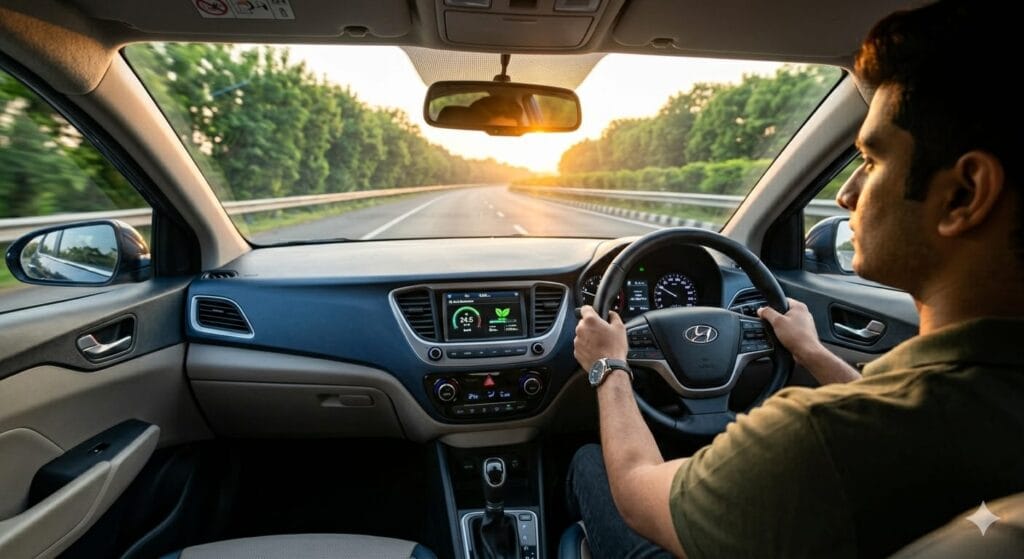
Eco-driving is not just a European concept anymore — it’s a proven method to cut fuel consumption by 15–20% without any hardware changes.
The core idea is simple: keep the engine in its most efficient RPM range. For most petrol cars, this is 1,500–2,500 RPM, and for diesel, it’s slightly lower.
Eco-driving essentials:
- Accelerate gently — imagine there’s a cup of water on your dashboard
- Anticipate traffic stops and coast to a halt instead of hard braking
- Maintain a steady speed rather than constant speed fluctuation
- Look ahead by 200–300 metres to read traffic flow
Modern cars like the Maruti Grand Vitara Hybrid and Honda City e:HEV have Eco Mode buttons that electronically soften throttle response and adjust gear shift points. Use them in city traffic — always.
Hack #4 — Switch to a Higher Gear Early
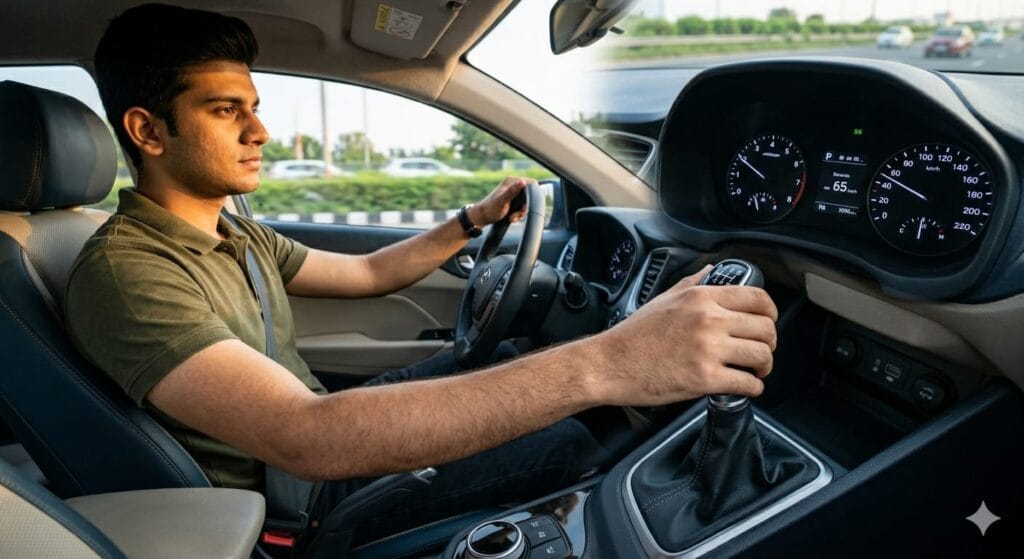
Many Indian drivers habitually stay in lower gears longer than necessary, which keeps the engine spinning at high RPM and burning excess fuel.
The rule of thumb: Shift up between 2,000–2,500 RPM for petrol cars and 1,800–2,000 RPM for diesel. On a clear road, aim to be in 5th or 6th gear by 60 km/h.
For automatic transmission cars — now increasingly common in India — select “S” (Sport) mode only when needed, and rely on “D” (Drive) mode for city commuting. Many 2025–2026 automatics also have an “Eco” transmission mode that holds higher gears longer.
Hack #5 — Avoid Aggressive Acceleration and Braking
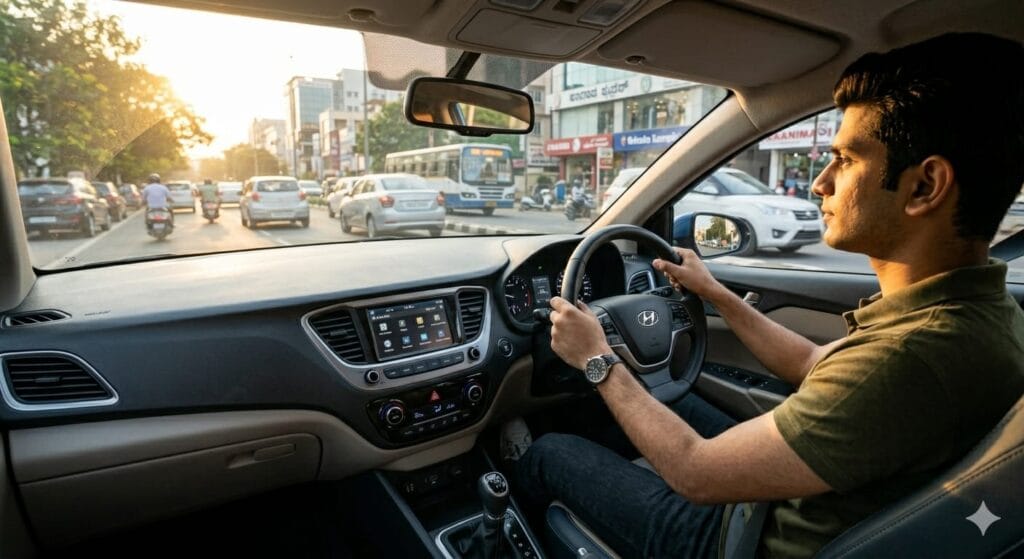
This is one of the biggest fuel wasters on Indian roads, especially in stop-and-go city traffic.
Hard acceleration followed by hard braking is essentially converting fuel into heat — twice. First when burning fuel to accelerate, then when wasting that kinetic energy through friction brakes.
Studies show that smooth driving vs. aggressive driving on the same route can show a fuel efficiency difference of 10–15%. For a car averaging 15 km/l, that’s the difference between 15 km/l and 13 km/l — which adds up to thousands of rupees annually.
Hack #6 — Use AI-Based Fuel Monitoring Apps
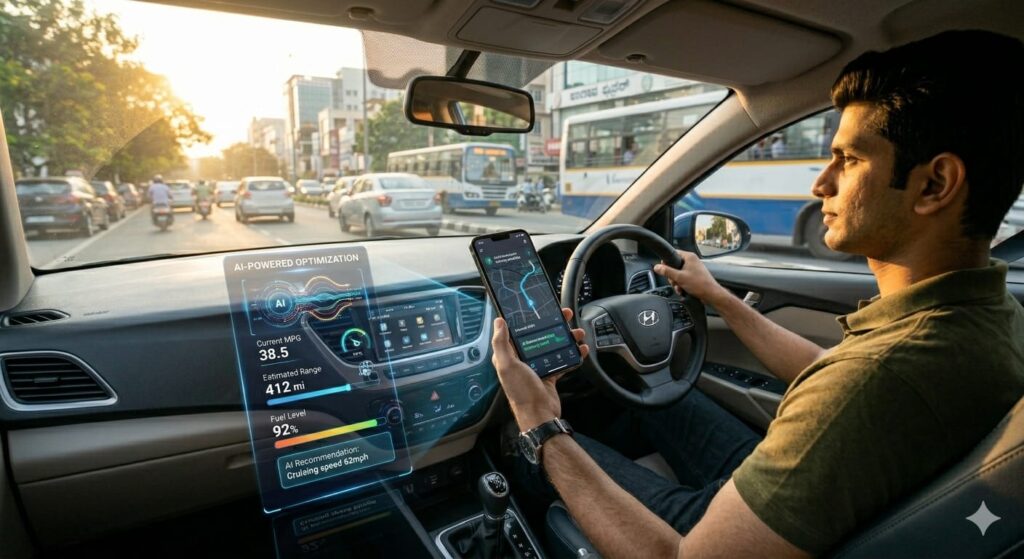
2026 is the year of the smart driver. A wave of AI-powered apps and OBD-II (On-Board Diagnostics) plug-in devices now make it possible to track your fuel consumption in real time.
Top tools available in India (2026):
- Carista OBD2 App — Works with VW, Skoda, Toyota, and more; gives instant MPL readings and driving scores
- Drivvo — Fuel log tracker with AI-powered mileage forecasts
- Google Maps Eco-Routing — Now integrates fuel-efficient route suggestions for Indian cities
- Built-in Connected Car Apps — Tata’s iRA, Hyundai’s BlueLink, and Maruti’s SmartPlay systems now offer trip-by-trip fuel analysis
By monitoring your driving patterns, these apps identify exactly where you’re losing fuel — whether it’s your morning warm-up idle, your expressway speed, or your AC habits.
Potential mileage gain: 5–12% by correcting AI-identified bad driving habits.
📌 Internal Link Suggestion: “Best OBD2 Scanners forindian cards in 2026″ [wheelinity.com]
Hack #7 — Keep Your Air Filter Clean
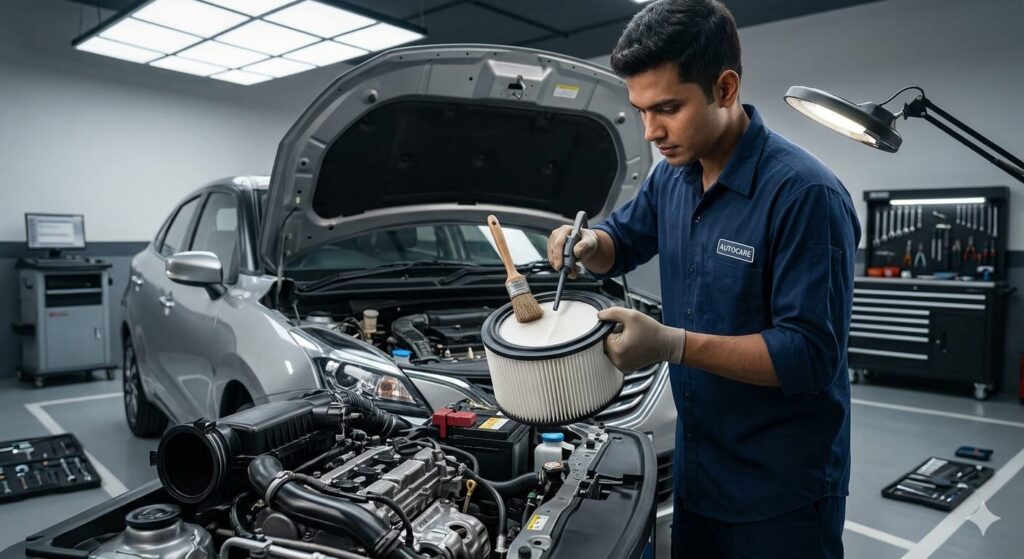
A clogged air filter restricts airflow to the engine, forcing it to run rich (more fuel, less air) — which directly tanks your mileage.
In India’s dusty road conditions — especially in cities like Jaipur, Lucknow, or Pune — air filters get dirty 2–3x faster than in European conditions.
Recommendation: Inspect the air filter every 10,000 km and replace it every 20,000–25,000 km, or sooner if you drive in high-dust areas. A new air filter costs ₹300–₹700 and can improve mileage by up to 10% on a neglected car.
Hack #8 — Plan Smarter Routes
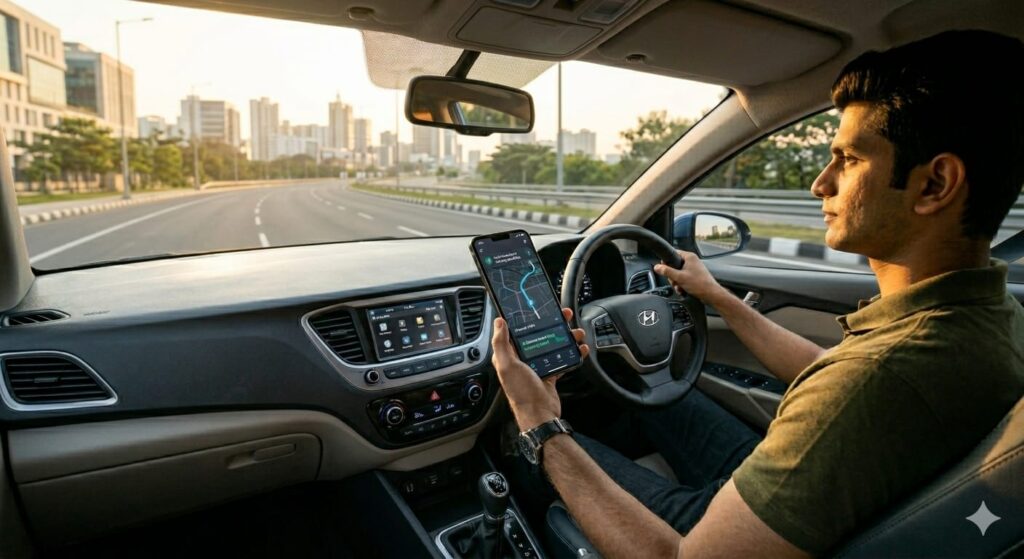
Navigation isn’t just about reaching faster — it’s about reaching with less fuel.
In 2026, Google Maps, Apple Maps, and Waze all feature fuel-efficient routing that avoids unnecessary elevation changes, heavy traffic zones, and signal-heavy corridors. Google Maps’ eco-routing feature, rolled out across major Indian cities in 2025, can reduce fuel consumption by 5–10% on urban routes.
Pro tip: If you have a choice between a slightly longer but flat route and a shorter but hilly route — often the flat route wins on fuel economy.
Also, combining errands into one trip instead of multiple short cold-start journeys saves significant fuel. A cold engine uses up to 40% more fuel in the first 5 km of operation.
Hack #9 — Reduce Unnecessary Load
Every extra kilogram in your car requires the engine to do more work. A 100 kg increase in vehicle weight typically reduces fuel efficiency by 0.3–0.5 km/l.
Look inside your car right now — is there a gym bag, spare parts, a broken stroller, or a boot full of things you haven’t needed in months? Clear it out.
Also, roof racks and carriers dramatically increase aerodynamic drag. An empty roof rack alone can reduce highway mileage by 2–5%. Remove them when not in use.

Hack #10 — Service Your Car on Schedule
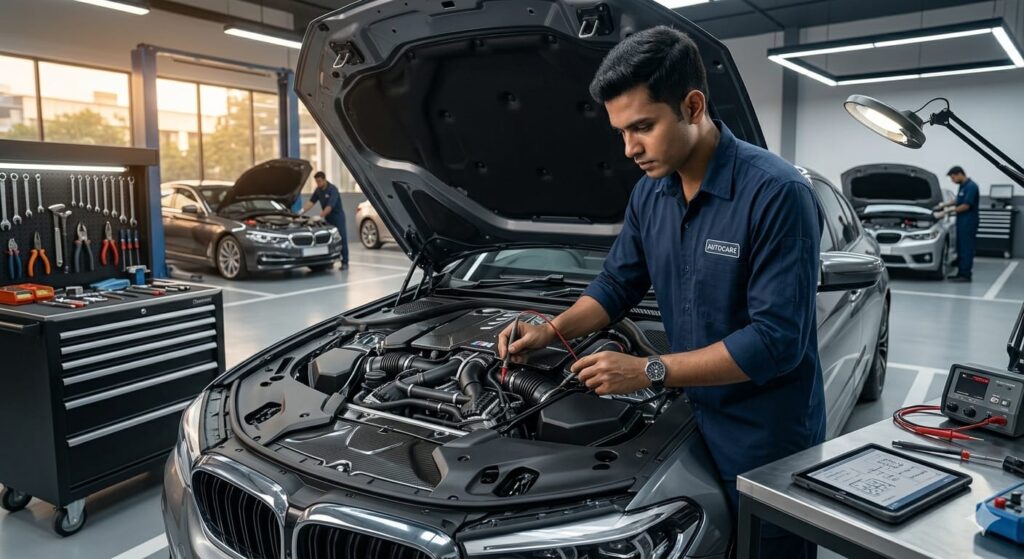
Skipping service intervals is a false economy. A car running on worn spark plugs, dirty fuel injectors, and a clogged fuel filter can lose 10–20% of its designed fuel efficiency — and you won’t even notice it happening gradually.
Critical service items that directly impact mileage:
- Spark plugs (petrol): Replace every 30,000–40,000 km
- Fuel injectors: Professional ultrasonic cleaning every 50,000 km
- Coolant: Incorrect operating temperature (due to thermostat failure) increases fuel use
- Wheel alignment and balancing: Misaligned wheels increase rolling resistance noticeably
For CNG cars specifically, the CNG kit’s pressure regulator and injectors need regular calibration — a badly tuned CNG system can dramatically reduce mileage per kilogram.
📌 Internal Link Suggestion: “Complete Car Service Checklist for Indian Road Conditions” — [Wheelinity.com]
Hack #11 — Use Cruise Control on Highways
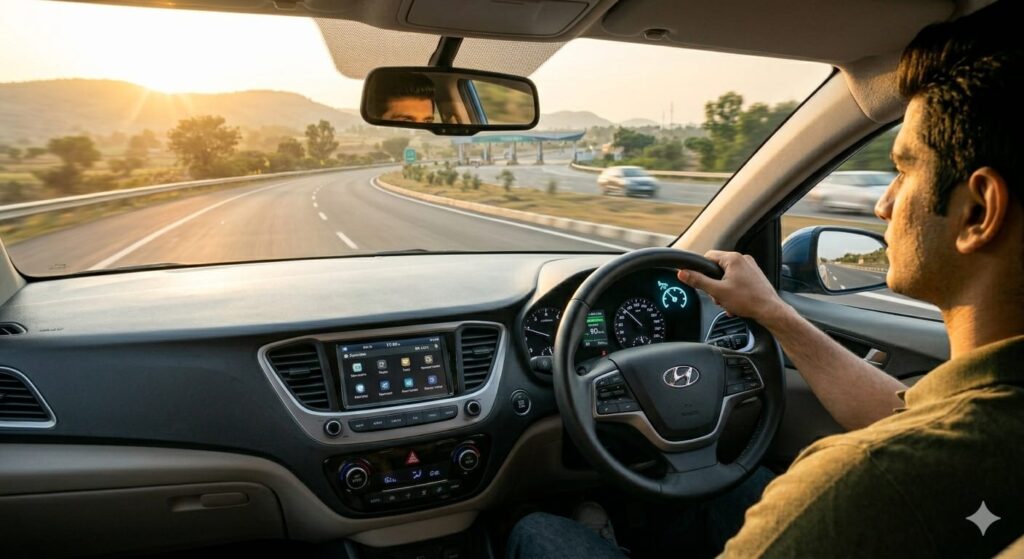
If your car has cruise control — and most cars above ₹8 lakh in India now do — use it on highways.
Maintaining a perfectly steady speed is something the human foot cannot do as well as an electronic system. Speed fluctuations even of 5–10 km/h on a highway cause repeated micro-accelerations that waste fuel.
Optimal cruising speed for fuel efficiency: Between 80–100 km/h on Indian expressways. Beyond 100 km/h, aerodynamic drag increases exponentially — a car at 120 km/h uses roughly 20–25% more fuel than the same car at 90 km/h.
Hack #12 — Park in the Shade
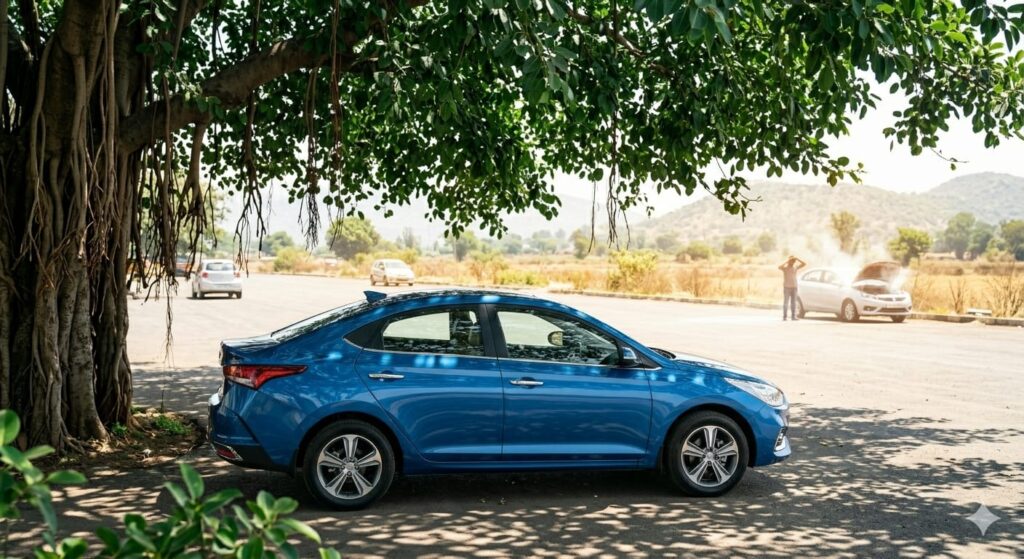
This might sound trivial, but fuel actually evaporates from your tank in hot conditions — especially in Indian summers where temperatures routinely cross 42°C.
Modern cars have carbon canister systems to capture fuel vapour, but parking in the sun also heats the cabin, which means your AC has to work much harder when you start the car, consuming more fuel for longer.
Shaded parking = cooler cabin = less AC load = better mileage. Simple chain, real savings — especially during April to June.
Hack #13 — Upgrade to Low-Rolling-Resistance Tyres
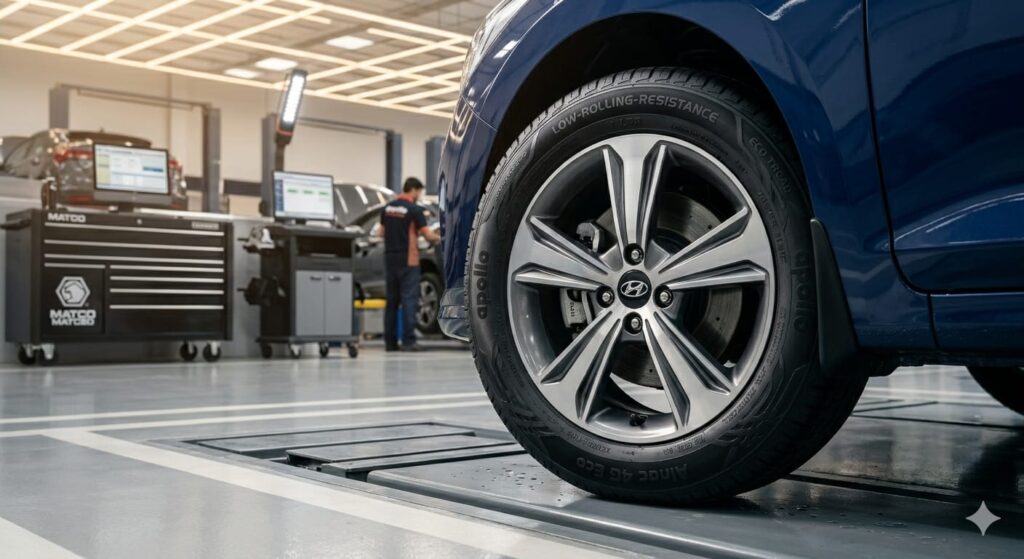
When it’s time to replace your tyres, consider low-rolling-resistance (LRR) options. These tyres use specially compounded rubber and optimised tread patterns to reduce the energy lost as heat as the tyre deforms.
Major tyre brands like MRF, Bridgestone, and Michelin now offer LRR variants for popular Indian car sizes. They can improve fuel economy by 3–7% compared to standard tyres — a meaningful gain over 4–5 years of tyre life.
They also run quieter on highways, which is a bonus for long-distance travellers.
Hack #14 — Keep Your AC Use Optimised
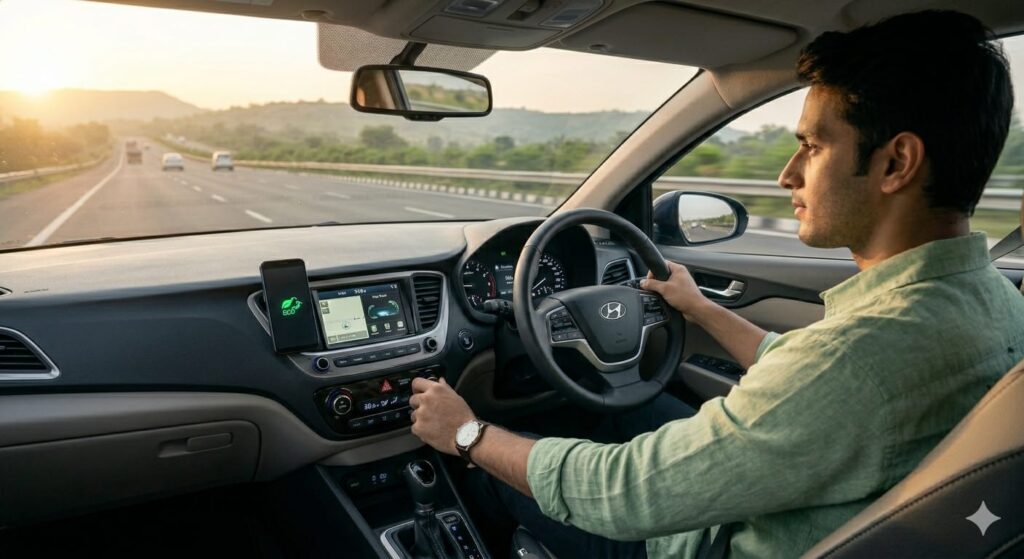
Air conditioning is one of the biggest fuel consumers in a car. In city traffic, running the AC on maximum can reduce fuel efficiency by 8–15% — more on smaller-engined cars.
Smart AC habits for 2026:
- Set the temperature to 24–25°C instead of the minimum. The compressor cycles off more frequently, reducing load.
- Use the “Auto” mode if your car has it — modern climate control systems are far more efficient than manual
- Use the recirculation mode once the cabin is cooled — cooling already-cooled interior air is far less work
- On early mornings or evenings, roll the windows down below 60 km/h and turn the AC off
For hybrid cars like the Maruti Grand Vitara or Toyota Hyryder, the electric AC compressor (which doesn’t draw from the engine) makes AC use far less of a penalty — use it more freely.
Hack #15 — Adopt Hypermiling Habits
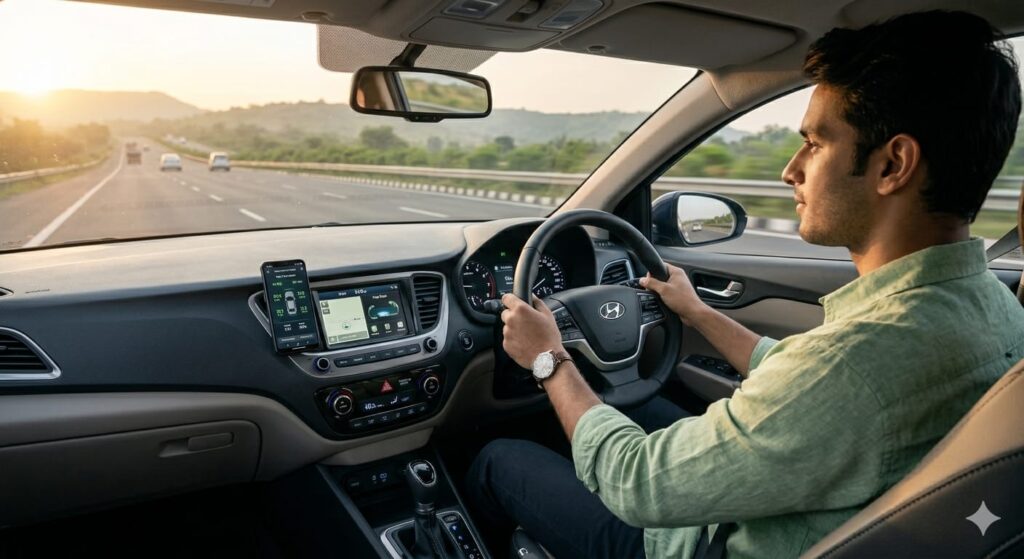
Hypermiling is the art of maximising fuel economy beyond standard eco-driving. Originally a motorsport technique, it’s now a mainstream practice among fuel-conscious drivers worldwide.
Key hypermiling techniques for Indian roads:
- Engine-off coasting: On a long downhill, shift to neutral and switch off the engine (only safe on controlled roads — know local traffic laws)
- Pulse and glide: Accelerate to target speed, then take foot off throttle and glide until speed drops, then accelerate again — works brilliantly on lightly trafficked roads
- Warm-up discipline: Never idle the engine for more than 30 seconds to warm up — modern fuel-injected engines warm up fastest under gentle load, not idle
- Overspeed avoidance: Every 10 km/h above 80 km/h costs approximately 1 km/l
Advanced hypermilers in India have reported achieving real-world mileage 20–30% above the standard driver average using these techniques consistently.
Pro Tips: Advanced Mileage Hacks for 2026
- Fuel up in the morning: Fuel is denser when cool, so you get marginally more energy per litre during cooler hours
- Use premium fuel selectively: High-compression engines (like those in the Hyundai Creta Turbo or Kia Seltos GT) genuinely benefit from 95-octane premium petrol — but standard engines don’t
- Battery health matters: In mild hybrids (MHEV) like the Maruti Ciaz or Ertiga, a degraded 48V battery means the electric assist kicks in less, raising fuel consumption
- Tyre rotation every 10,000 km: Even tyre wear maintains consistent rolling resistance across all four corners
- Watch your roof: Even a single kayak or cycle rack increases drag by 15–25% at highway speeds
Common Mileage Mistakes to Avoid
These are the habits that silently kill your fuel efficiency — even if you follow every hack above:
❌ Warming up the engine for 5–10 minutes before driving — modern EFI engines need only 20–30 seconds
❌ Filling the tank completely every time — a full tank adds 30–40 kg of weight; fill 70–80% if you drive in city traffic
❌ Ignoring the check engine light — a faulty oxygen sensor alone can reduce mileage by 20–40%
❌ Resting your foot on the clutch — partial clutch engagement creates friction and wears the plate
❌ Driving with one foot always on the brake — even light brake drag is a constant fuel drain
❌ Choosing the wrong fuel — using regular petrol in a car requiring premium (or vice versa) causes engine knock, misfires, and lost efficiency
❌ Over-revving in lower gears — especially common in manual diesel cars; shift up earlier
Frequently Asked Questions (FAQs)
Q1. What is the easiest way to improve car mileage immediately?
The easiest and most immediate improvement comes from checking and correcting your tyre pressure. An under-inflated tyre is the most common and most overlooked cause of poor mileage. Check pressure with a digital gauge and inflate to the manufacturer’s recommended PSI.
Q2. Does using AC always reduce car mileage?
Yes, but the degree varies. In city traffic, AC can reduce mileage by 8–15%. On highways at higher speeds, the fuel cost of AC becomes proportionally smaller compared to aerodynamic drag. Smart AC use (Auto mode, 24°C, recirculation) significantly reduces the fuel penalty.
Q3. How much mileage can I realistically improve with these hacks?
Most drivers who actively apply eco-driving, tyre pressure maintenance, and smart AC habits report improvements of 10–20% in real-world conditions. Disciplined hypermilers can do better. Improvements are most dramatic for drivers who currently have poor habits.
Q4. Are these mileage tips also applicable to CNG cars?
Absolutely. In fact, CNG car owners benefit even more because CNG is priced cheaper per equivalent km, so even small efficiency gains translate into meaningful per-km savings. Pay special attention to CNG kit calibration and tyre pressure for CNG vehicles.
Q5. Does a newer car always give better mileage than an older one?
Not necessarily — a well-maintained older car can outperform a newer car driven poorly. However, modern direct-injection engines, mild hybrid systems, and better aerodynamics do give newer cars a structural advantage. A well-maintained 2018 Maruti Swift vs a poorly maintained 2024 Swift can go either way.
Q6. How do AI fuel monitoring apps work?
These apps use either your smartphone’s GPS data or a physical OBD-II dongle plugged into your car’s diagnostics port (under the dashboard). They read real-time engine data — RPM, speed, throttle position, fuel injection data — and translate it into live fuel economy readings, driving score, and AI recommendations. Apps like Carista, Torque Pro, and manufacturer apps like Tata iRA and Hyundai BlueLink are popular in India.
Q7. Is it better to keep windows down or use AC for fuel efficiency?
At speeds below 60 km/h, open windows produce minimal aerodynamic drag — so turning off the AC and opening windows is more fuel-efficient. At speeds above 80 km/h, the aerodynamic drag from open windows typically exceeds the fuel cost of running AC — so at highway speeds, use the AC and keep the windows up.
Conclusion — Drive Smarter, Spend Less
Improving your car’s mileage in 2026 isn’t about any single magic trick. It’s about layering smart habits — from the moment you start the engine to the moment you park.
The 15 hacks in this guide have one thing in common: they’re all within your control today, without spending a fortune. Tyre pressure costs nothing to check. Eco-driving is free. Planning routes and clearing your boot takes five minutes.
Start with three hacks this week — tyre pressure, smooth acceleration, and using your car’s Eco mode. Track your fuel fills for the next month using a free app. The numbers will speak for themselves.
And if you want to stay ahead with the latest automotive tips, maintenance guides, new car reviews, and fuel-saving technologies for Indian roads — bookmark Wheelinity.com. We’re India’s go-to destination for smart car ownership.
Ready to drive smarter? Explore more expert guides, car comparisons, and mileage calculators only at Wheelinity.com →